
The mid-range smartphone market in 2026 is no longer a safety net for compromised technology; it is a fierce battlefield where top-tier engineering meets strict cost control. Over the last few years, a clear design trend has taken over the industry: phones have grown into massive, 7-inch devices that strain pockets and demand two-handed use.
Enter the Motorola Edge (2026). Launching at an MSRP of $599.99, this device makes a bold statement by going against the grain: it shrinks its screen from its predecessor’s 6.7 inches down to a highly pocketable, ergonomic 6.3 inches.
On paper, it promises a return to comfort without sacrificing modern features. But does it deliver? Over a week of intensive real-world testing, benchmarking in the lab, and daily use, a more complex reality emerges.
The Motorola Edge (2026) is a beautiful, remarkably durable, and incredibly bright device that feels fantastic in the hand. However, it faces a tough road ahead due to a $50 price increase, puzzling hardware downgrades, a weak silicon processor, and a critically short software lifecycle. This comprehensive review breaks down its design, display, performance, battery life, camera performance, and software ecosystem to help you decide if it deserves a spot in your pocket.
Market Context & The Cost of Volatility
To truly understand what the Motorola Edge (2026) brings to the table, we must first look at the competitive landscape of the mid-range market. At $599.99, Motorola has moved this line into a more expensive bracket, a shift likely driven by supply chain pressures and market volatility.
This price point places it in direct competition with two formidable rivals: the Google Pixel 10a ($499.00) and the Samsung Galaxy A57 ($549.99).
[2026 MID-RANGE PRICE MATRIX]
─────────────────────────────────────────────────────────────
Google Pixel 10a   : $499.00  ████████████████░░░░░ (Editors' Choice)
Samsung Galaxy A57 : $549.99  ██████████████████░░░ (Expandable Storage)
Motorola Edge 2026 : $599.99  █████████████████████ (Premium MSRP)
This price hike becomes even harder to justify when you look closely at the hardware specs. The 2025 Motorola Edge launched at $549.99 and offered a generous 256GB of onboard storage. The 2026 model, however, charges $50 more while cutting that storage capacity in half to a single 128GB/8GB RAM configuration with no option to upgrade.
Meanwhile, its competitors offer more flexibility. The Pixel 10a starts at $499 for 128GB, but allows you to match the Edge’s $599 price point to get a roomier 256GB model. The Samsung Galaxy A57 offers a baseline 128GB for $549.99, with a cheap $60 upgrade path to 256GB. By limiting users to 128GB with no option for expansion, Motorola starts this generation at a distinct disadvantage.
Design, Ergonomics, & Durability
While the internal specs raise some eyebrows, the physical design of the Motorola Edge (2026) is an absolute triumph. If you are tired of modern smartphones feeling like heavy bricks, this device will be a breath of fresh air.
                 [MID-RANGE PORTABILITY PROFILE]
                                │
       +────────────────────────┼────────────────────────+
       │                        │                        │
 [ Mass Comparison ]     [ Width Profile ]        [ Height Profile ]
 - Edge: 5.66 oz         - Edge: 2.83 inches      - Edge: 5.99 inches
 - A57 : 6.30 oz         - A57 : 3.02 inches      - A57 : 6.36 inches
 - 10a : 6.50 oz         - 10a : 2.87 inches      - 10a : 6.06 inches
Ergonomics in the Hand
Measuring just 5.99 by 2.83 by 0.28 inches (HWD) and weighing a feather-light 5.66 ounces, the Edge is incredibly compact. Compared to the chunky Galaxy A57 (6.33 oz) and the dense Pixel 10a (6.50 oz), the Edge feels effortless to use with one hand.
Motorola has also resisted the industry trend toward sharp, completely flat sides. Instead, the Edge features smooth, rounded edges finished in a reflective gold trim that rests comfortably in the palm without digging into your skin.
Aesthetic Execution
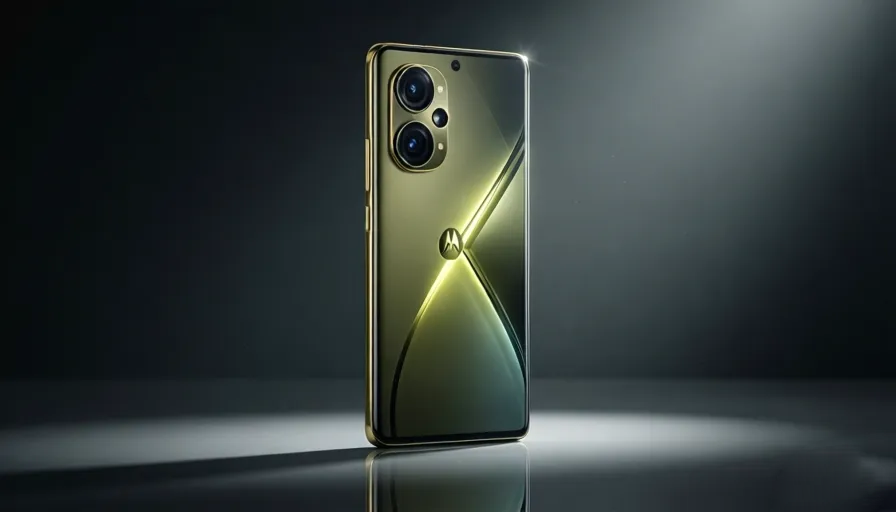
The phone is available in a single, distinct colorway: Pantone Martini Olive. The back panel features a twill-inspired textured finish that looks incredibly sophisticated.
As a practical bonus, this matte texture is entirely fingerprint-proof and grease-resistant, keeping the phone looking clean even after hours of use without a case. The rear camera system is housed in a raised gold module with a clean, beveled trim, creating a striking contrast against the deep olive green back.
Industrial-Grade Durability
Do not let the phone’s slim, elegant look fool you; its build quality is incredibly tough. The Edge outclasses almost every other mid-range phone on the market by offering three distinct durability ratings:
-
IP68 and IP69 Certification: While an IP68 rating (surviving submersion in five feet of water for 30 minutes) is standard for this price point, the Edge adds an IP69 rating. This means its internal seals can withstand close-range, high-pressure, and high-temperature water jets.
-
MIL-STD-810 Military Grade Standard: The chassis is officially certified to survive repeated drops onto hard surfaces from a height of up to four feet. It is also built to operate in extreme temperatures ranging from a freezing -4°F (-20°C) up to a blistering 140°F (60°C).
-
Corning Gorilla Glass 7i: The front display is shielded by Gorilla Glass 7i, a mid-tier glass designed to offer strong resistance against scratches and everyday drops.
Layout, Ports, and the AI Button
The right edge houses the volume rockers and a textured power button. The left side features a new physical AI Button.
While a dedicated physical button sounds useful, Motorola’s current software limits its potential. When you set it up, the system gives you only two options: map the button to launch Moto AI, or set it to No Action. You cannot use it to launch the camera, turn on the flashlight, or open a favorite app. It is truly AI or bust.
The bottom of the device contains a standard USB-C charging port, a single physical SIM card tray (complemented by internal eSIM support for dual-SIM setups), and a primary speaker grille.
Display Performance: Market-Leading Brightness
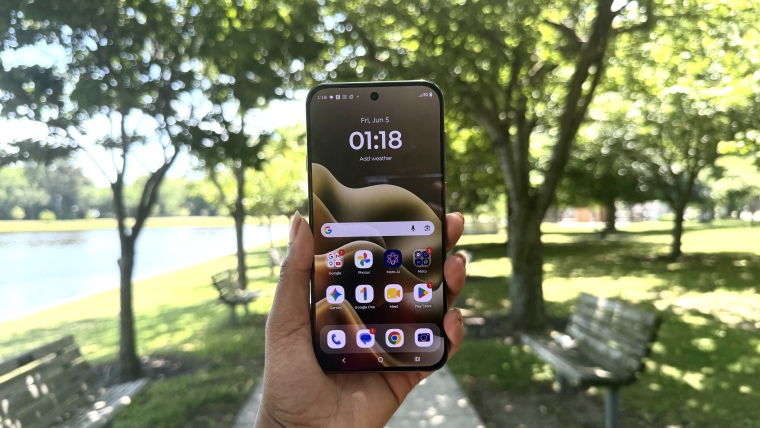
By reducing the screen size from 6.7 inches to 6.3 inches, Motorola was able to focus on delivering incredible display quality. The Edge features a 6.3-inch Extreme AMOLED panel with a razor-sharp resolution of 2,640 by 1,216 pixels. This yields a high pixel density that makes text look crisp and brings out fine details in photos and videos.
                 [PEAK PANEL LUMINANCE COMPARISON]
───────────────────────────────────────────────────────────────────────────
Samsung Galaxy A57 : 1,900 nits  ██████░░░░░░░░░░░░░░
Google Pixel 10a   : 3,000 nits  ███████████░░░░░░░░░
Motorola Edge 2026 : 5,200 nits  ████████████████████ (Ultra-Luminous)
The defining feature of this display is its incredible brightness. The panel hits a peak brightness of 5,200 nits, up from the already bright 4,500 nits of the 2025 model.
In real-world use, this screen easily overpowers harsh, direct sunlight. Reading web pages or watching videos outdoors is an absolute breeze, completely free from the muddy glare that plagues other mid-range phones.
By comparison, the Google Pixel 10a tops out at 3,000 nits, while the Samsung Galaxy A57 trails far behind at 1,900 nits. Furthermore, the Edge supports a fluid 120Hz refresh rate, ensuring that scrolling through social media feeds and navigating the user interface feels incredibly smooth.
However, there is one notable omission: the phone lacks an in-display fingerprint reader. While competitors like Samsung and Google include biometric fingerprint scanning under the glass, Edge users must rely on classic security methods like a PIN, pattern, password, or basic camera-based face unlock.
Compute Performance & Gaming Benchmarks
While the design and display are outstanding, the phone’s internal performance tells a very different story. Powering the Motorola Edge (2026) is a MediaTek Dimensity 7450 chipset, paired with 8GB of LPDDR5X RAM.
While everyday performance feels perfectly snappy—apps open quickly, home screens scroll smoothly, and a 175-page PDF loads in less than a second—benchmark testing reveals that this chip lags behind the competition.
CPU Performance: Geekbench 6
To measure processing power, we ran the Edge through Geekbench 6, which tests both single-core performance (everyday tasks) and multi-core performance (heavy multitasking).
                      [GEEKBENCH 6 BENCHMARK SCORES]
                                    │
       +────────────────────────────┼────────────────────────────+
       │                            │                            │
 [ Single-Core Muscle ]      [ Multi-Core Efficiency ]    [ Overall Hierarchy ]
 - Edge (7450): 1,112        - Edge (7450): 3,407         - 1st: Pixel 10a
 - A57 (1680) : 1,389        - A57 (1680) : 4,515         - 2nd: Galaxy A57
 - 10a (G5)   : 1,712        - 10a (G5)   : 4,477         - 3rd: Motorola Edge
The numbers show a clear gap. The Edge’s single-core score of 1,112 lags behind the Galaxy A57 (1,389) and is completely outclassed by the Pixel 10a’s Tensor G5 chip (1,712). Multi-core testing reveals a similar trend, with the Edge finishing last behind its mid-range rivals.
Graphics Performance: 3DMark Wild Life Extreme
The performance gap widens significantly when testing the graphics processor (GPU) with the demanding 3DMark Wild Life Extreme benchmark.
                [3DMARK WILD LIFE EXTREME GRAPHICS]
───────────────────────────────────────────────────────────────────────────
Motorola Edge (2026) : 1,064 Score  ██░░░░░░░░░ (6.37 FPS)
Samsung Galaxy A57   : 1,676 Score  ████░░░░░░░ (10.00 FPS)
Google Pixel 10a     : 2,703 Score  ███████░░░░ (16.19 FPS)
The Edge scored a very low 1,064 points with an average frame rate of just 6.37 fps. The Google Pixel 10a delivers more than double that graphical performance with a score of 2,703 (16.19 fps), making it much better suited for mobile gaming.
Real-World Gaming Test: Genshin Impact
To see how these benchmark numbers translate to real-world use, we fired up the notoriously demanding game Genshin Impact. Running the game at a custom 60fps preset quickly pushes the Dimensity 7450 chip to its limits.
Within 15 minutes of continuous play, the phone’s slim chassis warms up significantly. To prevent overheating, the system throttles the processor, causing a noticeable drop in frame rates and muddy, soft textures during combat.
This testing also revealed why Motorola includes a “No Action” setting for the physical AI button. Because of the phone’s compact size, it is incredibly easy to accidentally press that side button during intense gaming sessions, which brings up the Moto AI overlay right in the middle of a battle. Setting the button to “No Action” is a must for mobile gamers.
Battery Endurance & Charging Subsystems
Due to its smaller size, Motorola had to make another compromise: reducing the battery from the 2025 model’s 5,200mAh capacity down to a 5,000mAh battery.
Motorola claims this battery can deliver up to 50 hours of life under mixed-use conditions. However, synthetic lab testing paints a more realistic picture.
                     [PCMAG BATTERY LOOP TEST]
───────────────────────────────────────────────────────────────────────────
Google Pixel 10a   : 12 hrs, 15 mins  ████████████░░░░░░
Motorola Edge 2026 : 17 hrs, 25 mins  █████████████████░ (Impressive)
Samsung Galaxy A57 : 18 hrs, 20 mins  ██████████████████
Our battery test loops a 1080p video over Wi-Fi with the display set to maximum brightness. The Edge (2026) held on for an impressive 17 hours and 25 minutes before shutting down.
While it falls slightly short of the massive Galaxy A57 (18 hours and 20 minutes), it absolutely demolishes the Google Pixel 10a, which turned off after just 12 hours and 15 minutes. In normal daily use, the Edge easily delivers a full day and a half of battery life.
When it comes to charging speeds, Motorola offers excellent performance:
-
60W Wired Fast Charging: The Edge supports up to 60W wired charging speeds. When plugged into a compatible fast charger, the battery jumps from 0% to 28% in 15 minutes, hits 51% in 30 minutes, and reaches a full 100% charge in 1 hour and 6 minutes.
-
15W Wireless Charging: For added convenience, the phone supports 15W wireless charging on standard Qi pads.
By comparison, the Samsung Galaxy A57 maxes out at 45W wired charging and completely lacks wireless charging capability. The Google Pixel 10a supports wireless charging but limits wired speeds to a sluggish 30W.
Connectivity Standards & Cellular Testing
The Motorola Edge (2026) comes equipped with a modern array of wireless tech, including Wi-Fi 6E, Bluetooth 5.4, and NFC for contactless mobile payments.
For cellular connectivity, its 5G modem supports both standard Sub-6GHz and mid-band C-band frequencies. However, to keep costs down, the device lacks mmWave 5G hardware, meaning it cannot tap into the ultra-fast, short-range 5G networks found in select major city centers.
                 [REAL-WORLD 5G DOWNLOAD SPEEDS]
───────────────────────────────────────────────────────────────────────────
Motorola Edge (2026)   : 336 Mbps  ███████████░░░░░░░░░
iPhone 17 Pro Max      : 615 Mbps  ████████████████████ (Premium Modem)
We tested the phone’s cellular performance on Verizon’s 5G network in a busy shopping district on Long Island. The Edge reached a solid peak download speed of 336Mbps and an upload speed of 10Mbps. For comparison, a top-tier premium flagship device using an expensive, high-end modem hit 615Mbps down and 18.4Mbps up in the exact same location.
On home networks, the Edge performed beautifully. Connected to a standard Wi-Fi 6 router, it achieved fast speeds of 308Mbps down and 342Mbps up.
It also showed impressive signal retention at the very edge of the router’s range. Where premium flagships dropped down to 20.5Mbps down, the Edge held onto a stronger connection, pulling in a very respectable 42.2Mbps.
Acoustic Profiles: Call Quality vs. Dolby Atmos Speakers
The phone’s audio performance is a tale of two very different experiences, split between disappointing call quality and excellent speaker performance.
Voice and Call Quality
Phone calls made on the Edge are mediocre at best. In test recordings, voices are perfectly legible, but the audio has a faint, scratchy quality.
The microphone’s built-in noise cancellation is average, occasionally letting distracting background sounds leak through into the conversation. Additionally, the ear speaker is on the quieter side, measuring just 71.7dB with a sound meter placed six inches away.
Speaker Performance
In stark contrast to call quality, the media speakers are phenomenal. The Edge features two stereo speakers tuned with Dolby Atmos software.
When testing media playback at a distance of six inches, the speakers pumped out a loud, clear 81.3dB.
[DOLBY ATMOS SOFTWARE PRESET ENGINE]
───────────────────────────────────────────────────────────────────────────
 Smart Audio (Default) ──► Analyzes audio and balances profiles on the fly
 Spatial Audio         ──► Expands the virtual soundstage
 Music / Movie / Game  ──► Adjusts EQ for specific media types
Playing complex electronic tracks via Spotify reveals an impressive amount of depth and richness for a phone of this size. The built-in Dolby Atmos app includes presets for Spatial Audio, Music, Movie, Game, and Podcast.
Leaving the system on its default Smart Audio setting is the best option. It does a fantastic job of automatically tuning the equalizer on the fly to give your music and videos a full, well-balanced sound.
Camera Infrastructure: High Resolution With Punchy Processing
The rear camera module houses a versatile triple-camera system. Except for the 10MP telephoto lens, Motorola uses high-resolution 50MP sensors across the board.
                    [EDGE 2026 CAMERA TOPOGRAPHY]
                                  │
         +────────────────────────┼────────────────────────+
         │                        │                        │
 [ 50MP Main Camera ]     [ 50MP Ultra-Wide Lens ]  [ 10MP Telephoto Lens ]
 - Sony LYTIA 710 Sensor  - f/2.0 Aperture          - f/2.0 Aperture
 - f/1.8 Aperture         - 122-Degree Field View   - 3x Native Optical Zoom
 - Pixel-Bins to 12.6MP   - Dedicated Macro Mode    - Smooth Portrait Falloff
The Primary Sensor
The main camera gets a slight upgrade this year, moving to the Sony LYTIA 710 sensor (replacing the old Sony LYT700C). This new sensor improves low-light performance and reduces grain in dark areas.
By default, the camera uses a technique called pixel-binning to combine four pixels into one, delivering standard 12.6MP photos. If you want to capture maximum detail, you can easily toggle on a full 50MP high-resolution mode.
-
Color Profile (12.6MP Mode): The default binned shots use aggressive color processing. Colors look bright and punchy, pushing saturation levels higher than in real life. For instance, images of outdoor wood carvings or bright restaurant dishes show boosted reds, oranges, and greens that look highly vibrant but slightly artificial.
-
Detail Profile (50MP Native Mode): Switching over to the full 50MP resolution tempers down the intense saturation, delivering much truer-to-life colors. It also captures fine textures—such as the wood grain on a table or the rough surface of gravel—with excellent clarity.
Ultra-Wide & Macro Modes
The 50MP ultra-wide camera features a wide 122-degree field of view and an f/2.0 aperture. It does a fantastic job of managing tricky, high-contrast lighting.
When shooting wide city landscapes, the camera balances bright, sunny clouds without washing them out, while keeping darker shadow details under trees and buildings perfectly visible.
The ultra-wide lens also doubles as a Macro Camera for extreme close-up shots. When testing it on textured surfaces, it easily resolves fine details like the woven patterns in fabrics. However, when shooting organic subjects like flowers, the edges can look a bit soft and lose some definition.
Telephoto Performance
The 10MP telephoto lens features an f/2.0 aperture and a native 3x optical zoom. It is an excellent tool for tight framing, allowing you to isolate a subject (like a cocktail on a table) and create a smooth, natural background blur.
However, the sensor can struggle with distant moving subjects. Taking a 3x zoom photo of wildlife from a few feet away can result in soft edges and a loss of fine detail.
Front-Facing Selfie Camera
The front screen features a hole-punch cutout for a 50MP selfie camera with an f/1.95 aperture. Unlike the rear camera, the selfie camera avoids heavy color processing, delivering realistic skin tones and sharp details.
In Portrait Mode, the edge detection works beautifully. The software cleanly separates your subject from the background, even around tricky areas like loose hair strands.
Video Capture Capabilities
The Motorola Edge (2026) can record video at up to 4K resolution at 30fps. Recorded clips look vibrant with accurate color reproduction, but the overall image sharpness is lacking.
Fine details tend to look soft, meaning you won’t get the ultra-crisp, cinematic look found on more expensive flagship devices.
Software Lifecycle & Moto AI Features
The Motorola Edge (2026) ships with Android 16. While the software experience is clean and highly customizable, Motorola’s support policy remains a major disappointment.
                    [SOFTWARE SUPPORT WINDOWS]
───────────────────────────────────────────────────────────────────────────
Motorola Edge (2026) : 2 Years OS  | 3 Years Security  ███░░░░░░░
Samsung Galaxy A57   : 6 Years OS  | 6 Years Security  ████████░░
Google Pixel 10a     : 7 Years OS  | 7 Years Security  ██████████
Motorola commits to providing only two years of major Android operating system upgrades and three years of bi-monthly security updates. This short support window makes the phone difficult to recommend if you plan on keeping your device for a long time.
By comparison, Samsung offers six years of full support for the Galaxy A57, and Google promises an incredible seven years of updates for the Pixel 10a. This leaves the Edge feeling outdated well before its hardware should give out.
The Moto Personalization Hub
On a more positive note, the preinstalled Moto App serves as an excellent, centralized hub for customizing your device. You can easily tweak your theme, change fonts, and set up Motorola’s classic, incredibly useful gesture controls.
For instance, you can program the phone to turn on Do Not Disturb simply by flipping it face-down on a table, or use a quick three-finger swipe to instantly split your screen between two running apps.
Moto AI Integration
Navigating to the standalone Moto AI app opens up several new artificial intelligence tools:
[MOTO AI APPLICATION SUITE]
 ├── Image Studio ──► Generates custom stickers/avatars from sketches and text prompts
 ├── Remember This ──► Instantly captures and saves important on-screen content
 └── Catch Me Up   ──► Creates quick, bulleted text summaries of notification backlogs
The app features an Image Studio that lets you create custom AI stickers, avatars, and graphics using text prompts or basic drawings. However, this feature is restricted by a daily allowance of six free creation credits, which you can easily burn through in a few minutes.
On the practical side, Moto AI offers two genuinely useful tools: Remember This, which lets you quickly pin and save important contextual information, and Catch Me Up, which condenses a long backlog of missed texts, app alerts, and emails into a clean, easy-to-read summary.
The Verdict: Who Is the Edge (2026) For?
The Motorola Edge (2026) is a good smartphone that feels like a victim of a volatile market. It is an incredibly comfortable, beautifully crafted device that packs one of the brightest and most beautiful displays available on a mid-range phone.
Its excellent water resistance and durable build mean it can easily handle the wear and tear of daily life.
               [PROS AND CONS SUMMARY BALANCING MATRIX]
===========================================================================
[+] STRENGTHS                              [-] WEAKNESSES
───────────────────────────────────────────────────────────────────────────
* Unmatched 5,200-nit AMOLED Display       * 128GB Storage Cut (No 256GB Path)
* Lightweight, 5.66 oz Ergonomic Body      * Slow MediaTek Processing Unit
* IP68/IP69 & Military Grade Build         * Poor 2-Year OS Support Window
* Long-Lasting 17-Hour Battery Life        * No In-Display Fingerprint Scanner
===========================================================================
However, at $599.99, it is a tough sell. By cutting the baseline storage down to 128GB, using a weak MediaTek processor that struggles with gaming, omitting a fingerprint scanner, and offering a short two-year software update policy, Motorola has made too many compromises.
-
Buy it if: You prioritize ergonomics above all else, want a compact phone that is easy to use with one hand, need military-grade durability, and want an ultra-bright screen that looks incredible outdoors.
-
Skip it if: You are looking for the best value for your dollar, need plenty of internal storage for apps and media, play graphically intense mobile games, or want a phone that will stay updated with the latest software for the next five to seven years.
FAQ
1. What is the Motorola Edge (2026)?
The Motorola Edge (2026) is a premium mid-range smartphone released in 2026 with a starting price of $599.99. It features a compact 6.3-inch AMOLED display, MediaTek Dimensity 7450 processor, 5,000mAh battery, 50MP main camera, and Android 16 software.
2. How much does the Motorola Edge (2026) cost?
The Motorola Edge (2026) launches at an MSRP of $599.99 for the only available configuration, which includes 128GB of storage and 8GB of RAM.
3. How does the Motorola Edge (2026) compare to the Pixel 10a and Galaxy A57?
The Motorola Edge (2026) offers a brighter display, better durability ratings, and a more compact design. However, the Google Pixel 10a provides stronger processing power and longer software support, while the Samsung Galaxy A57 offers expandable storage and longer update commitments.
4. What screen size does the Motorola Edge (2026) have?
The device features a 6.3-inch Extreme AMOLED display, making it significantly smaller and more pocket-friendly than many competing smartphones that exceed 6.7 inches.
5. Is the Motorola Edge (2026) good for one-handed use?
Yes. Due to its compact dimensions, lightweight 5.66-ounce body, and rounded frame design, it is one of the most comfortable smartphones for one-handed operation in 2026.
6. What is the display resolution of the Motorola Edge (2026)?
The screen resolution is 2640 x 1216 pixels, providing sharp text rendering, excellent image clarity, and high pixel density.
7. How bright is the Motorola Edge (2026) display?
The display reaches a peak brightness of 5,200 nits, making it one of the brightest smartphone screens available in the mid-range category.
8. Does the Motorola Edge (2026) support a 120Hz refresh rate?
Yes. The display supports a smooth 120Hz refresh rate, improving scrolling, animations, gaming responsiveness, and overall user experience.
9. Does the Motorola Edge (2026) have a fingerprint scanner?
No. The device lacks an in-display fingerprint scanner and instead relies on PIN, pattern, password, and facial recognition methods.
10. What processor powers the Motorola Edge (2026)?
The smartphone uses the MediaTek Dimensity 7450 chipset paired with 8GB of LPDDR5X RAM.
11. Is the Motorola Edge (2026) good for gaming?
It can handle casual and moderate gaming well, but demanding titles such as Genshin Impact may experience thermal throttling, reduced frame rates, and lower graphical performance compared to competitors.
12. How does the Motorola Edge (2026) perform in benchmarks?
Benchmark results place it behind the Google Pixel 10a and Samsung Galaxy A57 in both CPU and GPU performance tests.
13. How much storage does the Motorola Edge (2026) offer?
The phone includes 128GB of internal storage and 8GB of RAM. There is no 256GB version available.
14. Does the Motorola Edge (2026) support expandable storage?
No. The device does not include a microSD card slot for storage expansion.
15. How long does the battery last?
In testing, the Motorola Edge (2026) achieved approximately 17 hours and 25 minutes of continuous video playback, providing excellent all-day battery life.
16. What battery capacity does the Motorola Edge (2026) have?
The device is equipped with a 5,000mAh battery.
17. Does the Motorola Edge (2026) support fast charging?
Yes. It supports 60W wired fast charging and can reach a full charge in approximately 66 minutes.
18. Does the Motorola Edge (2026) support wireless charging?
Yes. The phone supports 15W wireless charging using Qi-compatible chargers.
19. How durable is the Motorola Edge (2026)?
The device is exceptionally durable with IP68 certification, IP69 certification, MIL-STD-810 military-grade durability, and Corning Gorilla Glass 7i protection.
20. What does IP68 certification mean?
IP68 certification means the phone can survive immersion in water up to approximately 5 feet deep for up to 30 minutes.
21. What does IP69 certification mean?
IP69 certification indicates resistance to high-pressure and high-temperature water jets, offering enhanced protection compared to standard waterproof ratings.
22. What cameras are included on the Motorola Edge (2026)?
The phone includes:
- 50MP Main Camera
- 50MP Ultra-Wide Camera
- 10MP Telephoto Camera with 3x Optical Zoom
- 50MP Front Selfie Camera
23. How good is the main camera?
The primary camera delivers vibrant colors, strong dynamic range, impressive detail, and improved low-light performance thanks to the Sony LYTIA 710 sensor.
24. Does the Motorola Edge (2026) support macro photography?
Yes. The ultra-wide camera doubles as a macro camera for close-up photography.
25. How good is the telephoto camera?
The 10MP telephoto camera provides 3x optical zoom and performs well for portraits and close subjects but can struggle with distant moving objects.
26. How does the selfie camera perform?
The 50MP selfie camera captures detailed images, natural skin tones, and effective portrait separation with accurate edge detection.
27. Can the Motorola Edge (2026) record 4K video?
Yes. The device supports 4K video recording at 30 frames per second.
28. What software does the Motorola Edge (2026) run?
It ships with Android 16 and Motorola’s custom Moto software enhancements.
29. How many years of software updates will Motorola provide?
Motorola promises:
- 2 years of Android OS upgrades
- 3 years of security updates
30. Why is software support considered a weakness?
Competing devices like the Pixel 10a and Galaxy A57 offer significantly longer support periods, making them better long-term investments.
31. What is the AI Button on the Motorola Edge (2026)?
The dedicated AI Button launches Motorola’s Moto AI system. Users can either assign it to Moto AI or disable it entirely.
32. What AI features are available?
Moto AI includes:
- Image Studio
- Remember This
- Catch Me Up
- AI-generated stickers and avatars
- Notification summaries
33. Does the Motorola Edge (2026) support 5G?
Yes. It supports both Sub-6GHz and C-band 5G networks.
34. Does the Motorola Edge (2026) support mmWave 5G?
No. The device does not include mmWave 5G hardware.
35. What wireless technologies are included?
The phone supports:
- Wi-Fi 6E
- Bluetooth 5.4
- NFC
- eSIM
- Dual SIM functionality
36. How are the speakers?
The stereo speakers are among the strongest aspects of the phone, delivering loud and clear Dolby Atmos-enhanced audio.
37. Is call quality good?
Call quality is acceptable but not exceptional. Voices remain understandable, though audio may sound slightly scratchy and the earpiece volume is relatively modest.
38. Who should buy the Motorola Edge (2026)?
The device is ideal for users who prioritize:
- Compact design
- Comfortable one-handed use
- Exceptional screen brightness
- Strong durability
- Long battery life
39. Who should avoid the Motorola Edge (2026)?
Consider alternatives if you need:
- Better gaming performance
- Larger storage options
- Longer software support
- Fingerprint authentication
- Maximum value for money
40. Is the Motorola Edge (2026) worth buying?
The Motorola Edge (2026) is a solid smartphone with excellent design, display quality, durability, and battery life. However, its limited storage, weaker processor, and short software support make it less competitive against similarly priced rivals.