

For the better part of a decade, buying a flagship smartphone has felt like signing a psychological contract with a series of compromises. If you wanted the smartest artificial intelligence capabilities and an integrated stylus, you paid a small fortune for a Samsung Ultra. If you wanted a pristine, computational camera experience that understood the nuances of human skin tones and natural lighting, you accepted the mediocre thermal management and subpar battery life of a Google Pixel. And if you opted for a OnePlus device, you generally accepted a beautiful, fast phone that lacked top-tier durability ratings and lagged slightly behind in camera processing consistency.
In 2026, that contract has been torn to shreds.
The arrival of the OnePlus 15 represents more than just an incremental spec bump or an annual hardware refresh. It marks a foundational, philosophical rethink in how a premium Android smartphone can be engineered. Priced at a refreshingly competitive $899.99, the OnePlus 15 takes direct aim at the thousand-dollar-plus strongholds of its primary competitors. It completely discards the curved, slippery design aesthetics of its predecessors, steps boldly into the boxy, structural arena dominated by the Galaxy S25 Ultra and Pixel 10 Pro XL, and introduces a proprietary battery technology that doesn’t just edge out the competition—it annihilates them.
Boasting a colossal 7,300mAh battery that utilizes advanced Silicon NanoStack material science, the OnePlus 15 achieves something long thought impossible in modern smartphone form factors: genuine, multi-day heavy-use endurance without looking or feeling like a ruggedized, bulky brick.
In this exhaustive, real-world analytical review, we will dissect every millimeter of this fascinating device. From its unique micro-arc oxidized stone-like finish and its blistering 165Hz display capabilities to its post-Hasselblad computational camera logic and its futureproof network architecture, we uncover whether the OnePlus 15 is truly the undisputed king of practical performance, or if its benchmark anomalies and carrier limitations hold it back from absolute market dominance.
Unboxing and First Impressions: A Distinct Visual Metamorphosis

Unboxing a OnePlus device has always been a distinct experience, primarily due to the company’s insistence on keeping the iconic red-and-white color palette alive. While Apple, Samsung, and Google have stripped their packaging down to minimalist, wafer-thin cardboard envelopes under the banner of environmental sustainability—removing charging bricks and accessories in the process—OnePlus continues to offer a premium, fully-loaded unboxing experience.
Pop open the heavy-gauge red box, and you are immediately greeted by the phone itself, nestled securely above a compartment that holds a beefy, proprietary 80W SuperVooc power adapter and the signature thick, braided red USB-C to USB-A/C cable. For a device costing $899.99, the inclusion of a high-speed charging brick that would easily cost an additional $50 to $70 from third-party manufacturers is an immediate consumer value win.
Lifting the OnePlus 15 out of its tray reveals the massive design departure Eric Zeman highlighted in his initial analysis. If you have owned a OnePlus 11, 12, or 13, your muscle memory will immediately register that something radical has occurred. The razor-thin aluminum mid-frames, the aggressively tapered dual-curved front and back glass panels, and the sprawling, offset circular camera humps that defined the brand for years are completely gone.
Instead, you are holding a structural, blocky, unapologetically dense piece of hardware. It features completely flattened side rails, crisply defined corners, and a symmetrical, centered camera module that feels immensely stable. It is a design language that clearly respects the structural choices made by the Google Pixel 10 Pro XL and the Samsung Galaxy S25 Ultra, yet it manages to carve out an entirely unique tactile identity thanks to an innovative material finish that feels less like cold industrial metal and more like a sculpted piece of the earth.
Deep-Dive Specification Architecture
To understand how the OnePlus 15 achieves its performance and endurance metrics, we must first look at the raw silicon and structural components under the hood. Below is the comprehensive technical breakdown of the OnePlus 15 as it compares to the absolute heaviest hitters in the 2026 mobile space.
Industrial Design: When Ceramic Processing Mimics Stone
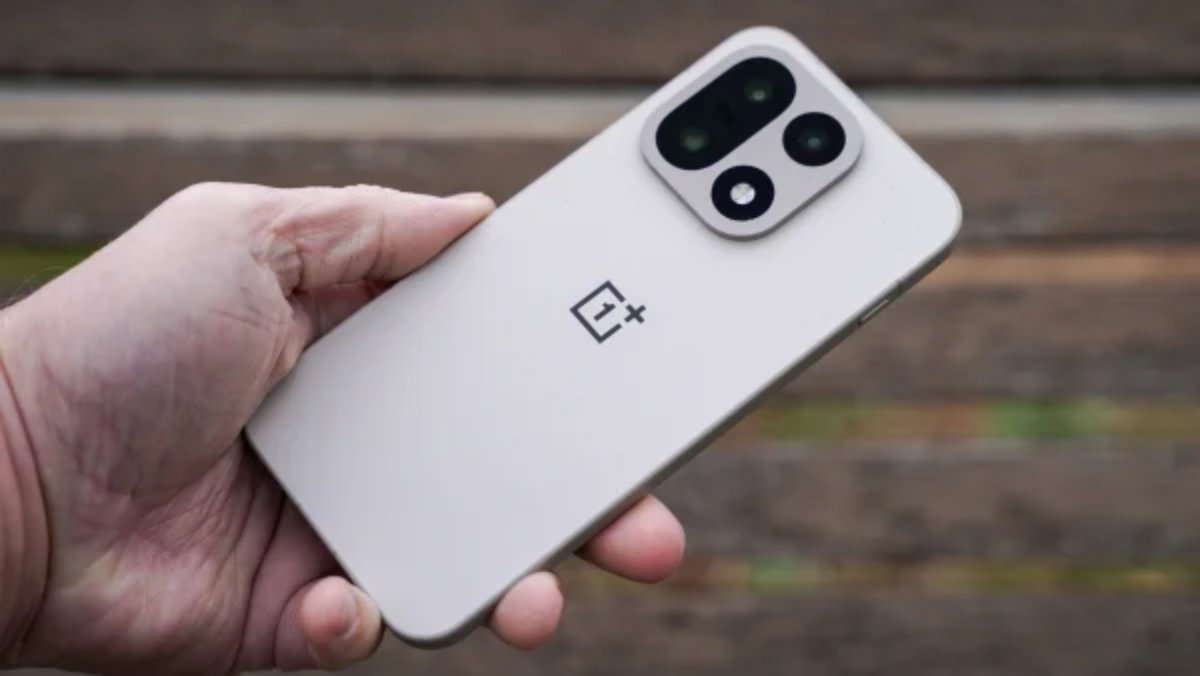
At 6.35 by 3.02 by 0.32 inches and a weight of 7.44 ounces, the OnePlus 15 manages to be an absolute engineering marvel. When you consider that it houses a battery that is roughly 46% larger than the cell inside the Samsung Galaxy S25 Ultra, you expect a phone that feels like an extended-battery construction tool. Yet, the OnePlus 15 is actually thinner than the Google Pixel 10 Pro XL (0.32 inches vs 0.33 inches) and weighs noticeably less (7.44 oz vs 8.18 oz).
How did OnePlus achieve this spatial wizardry? The secret lies in a complete overhaul of their metallurgy and chassis coating methodology.
The Micro-Arc Oxidation Matrix
OnePlus has implemented an aerospace-grade material process known as micro-arc oxidation (MAO). This technique applies a high-voltage, plasma-based electrochemical discharge directly to the phone’s metallic substrate frame. The intense thermal energy of the plasma alters the crystalline surface structure of the metal, creating an ultra-dense, thin ceramic overlay right on top of the structural frame.
The tactile result of this process is outstanding. In the hand, whether you choose Infinite Black, Sand Storm, or Ultra Violet, the phone does not possess the sterile, fingerprint-magnet coldness of polished titanium or anodized aluminum. Instead, it feels uniquely biological—almost like a piece of premium, dense, water-worn river stone or highly compressed, hardened clay. It strikes a remarkable physical paradox: it is incredibly smooth to the touch, yet it offers a dry, tactile friction that makes it exceptionally grippy and secure when handled without a case.
Military-Grade Water Defiance: Breaking the IP69K Barrier
While almost every mainstream flagship phone over the last five years has proudly carried an IP68 rating, OnePlus has gone significantly further, securing full certification for IP66, IP68, IP69, and IP69K.
To put this in perspective, let us look at what these ratings actually mean for real-world survivability:
-
IP66: Protection against heavy seas or powerful jets of water from any direction.
-
IP68: Continuous submersion in fresh water down to 2 meters (6.5 feet) for up to 30 minutes.
-
IP69 / IP69K: Continuous protection against high-pressure, close-range water streams, specifically tested with severe high-temperature fluid jets (up to 80°C or 176°F) directed at the chassis from multiple angles.
This means the OnePlus 15 isn’t just protected against dropping into a calm swimming pool or a puddle. It is built to survive high-velocity marine environments—whether strapped into an open pocket while jet-skiing, exposed to torrential rainforest downpours, or accidentally sprayed down directly with water hoses. This level of ingress protection is typically reserved for thick, specialized industrial field devices, making its inclusion in an elegant $899 flagship a staggering achievement in hardware sealing.
Button Architecture and the Extinction of the Alert Slider
Looking around the frame, long-time fans will notice a controversial omission: the mechanical three-stage alert slider—a hardware staple of premium OnePlus legacy devices—has been completely deleted.
In its place on the left rail sits a singular, low-profile utility button that behaves identically to Apple’s Action Button. A sustained long-press can be mapped inside OxygenOS to trigger one of eight essential system tasks:
-
Activating the high-output LED flashlight.
-
Opening the voice recorder instantly.
-
Launching the system camera app.
-
Toggling system accessibility features.
-
Launching a user-defined app shortcut.
-
Triggering a custom macro routine.
-
Activating system-wide mute profiles.
-
Initiating an immediate emergency SOS routine.
The power and volume buttons reside on the right rail. While perfectly functional, their flat, low-profile seating into the micro-arc oxidized frame gives them a slightly mushy, dampened travel distance. They lack the sharp, tactile, metallic click feedback found on the Galaxy S25 Ultra, which may disappoint users who prefer highly clicky, mechanical interfaces.
The Display: A Bright, Blistering 165Hz Visual Arena
The front face of the OnePlus 15 is dominated by a gorgeous 6.78-inch Low-Temperature Polycrystalline Oxide (LTPO) AMOLED panel. Interestingly, OnePlus chose to slightly scale back both the physical footprint and the absolute raw pixel resolution compared to the outgoing OnePlus 13, which offered a 6.82-inch screen at a quad-HD resolution of 3,168 by 1,440.
The OnePlus 15 sports a native resolution of 2,772 by 1,272 pixels. In standard operation, this configuration yields a pixel density of 450 ppi. While technical spec purists might see this reduction on paper as a step backward, in real-world environments, the human eye cannot discern individual pixels at anything above 400 ppi at standard viewing distances. By running a highly optimized 1.5K resolution panel rather than a full 2K matrix, OnePlus significantly reduces the processing load on the GPU and lowers screen power consumption, all while keeping the display incredibly sharp.
                     THE HIGH-REFRESH DISPLAY MATRIX

  [ Standard Apps & UI ] ──────► Dynamic Variable Refresh: 1Hz to 120Hz

  [ Advanced Gaming Mode ] ────► Maximum Unlocked Ceiling: Up to 165Hz
Breaking the 120Hz Barrier: 165Hz Mobile Gaming
Where this screen truly sets itself apart from both Apple and Samsung is its dynamic refresh capability. While standard system operations, web browsing, and movie playback scale intelligently between 1Hz and 120Hz based on content movement to preserve power, launching the integrated Gaming Mode completely unlocks the panel’s ceiling, driving it all the way up to 165Hz.
This makes the OnePlus 15 behave less like a standard corporate phone and more like a dedicated, high-performance gaming laptop screen. When running fully optimized titles like Call of Duty: Mobile or Clash of Clans, the animation tracking, touch-response latency, and panning smooth-motion accuracy are completely flawless. The visual experience feels remarkably immediate, providing a genuine competitive advantage in fast-paced competitive shooters where millisecond frame transitions dictate target acquisition.
Outdoor Illumination Metrics
OnePlus has simultaneously upgraded the panel’s standard sustained illumination limits. The screen pushes an impressive average sustained outdoor brightness of 1,800 nits, a noticeable leap from the 1,600 nits of the prior model. This ensures that even under direct, harsh midday sunlight, reading complex spreadsheets, viewing detailed maps, or composing photos requires absolutely no squinting.
A Quick Tip for Hardware Longevity: The OnePlus 15 arrives with a factory-installed, flexible plastic screen protector. While useful for preventing immediate scratches right out of the box, the material composition of this plastic layer easily attracts smudges, facial oils, fine dust, and stray hairs. For an uncompromised, pristine visual experience, we highly recommend peeling off this plastic film and replacing it with a premium, oleophobic tempered glass protector.
Performance and Synthetic Benchmark Analysis
The OnePlus 15 is among the vanguard of devices to adopt Qualcomm’s cutting-edge Snapdragon 8 Elite Gen 5 processor. Built on a highly efficient sub-3nm lithography node, this system-on-a-chip (SoC) discards traditional low-power efficiency cores entirely, opting instead for a cluster of high-performance custom CPU cores paired with a monstrously powerful graphics sub-engine.
Our review unit represents the baseline $899.99 configuration, equipped with 12GB of LPDDR5X RAM and 256GB of ultra-fast UFS 4.1 storage. For power users or media hoarders, a $999.99 tier steps the system memory up to 16GB of RAM and 512GB of internal storage.
Unfortunately, OnePlus has chosen not to offer a 1TB storage variant this generation, and the device completely lacks a microSD slot for hardware expansion. This is an area where Samsung and Google hold a clear structural advantage for content creators, offering cavernous 1TB configurations, albeit at premium price tiers that easily eclipse $1,500.
The Thermal Management Infrastructure
To prevent the Snapdragon 8 Elite Gen 5 from thermal throttling under sustained computation, OnePlus engineered the 360 Cryo-Velocity Cooling System. This setup features a massive 3D vapor chamber measuring a generous 8.89 square inches. This multi-layered layout wraps directly around the primary motherboard, quickly drawing heat away from the silicon core and spreading it evenly across the frame to prevent localized hot spots.
The Benchmarking Paradox: Real-World Speed vs. Synthetic Limits
When interpreting laboratory benchmark results for the OnePlus 15, we encounter an interesting software-driven paradox. Let us examine the standardized processing data across three major synthetic suites:
               GEEKBENCH 6 SUITE (RAW CPU THREADING)

  OnePlus 15         █ 3,669 (Single)  ███████████ 11,333 (Multi)
  Galaxy S25 Ultra   █ 3,121 (Single)  █████████ 9,937 (Multi)
  Pixel 10 Pro XL    █ 2,340 (Single)  ██████ 6,430 (Multi)
In pure raw compute scenarios like Geekbench 6, the OnePlus 15 absolutely flies. Its single-core metric of 3,669 and multi-core score of 11,333 easily outdistance both the Snapdragon 8 Elite inside the Galaxy S25 Ultra and the custom Tensor G5 inside the Pixel 10 Pro XL.
However, when transitioning to complex, multi-variable workflow simulation suites, things take an unexpected turn:
-
PCMark 3.0 Work Performance: The OnePlus 15 achieves a score of 16,657. Surprisingly, the Pixel 10 Pro XL edges past it at 15,722, while the Samsung Galaxy S25 Ultra dominates the field with an incredible score of 20,502. Even legacy hardware like the older Galaxy S24 Ultra scores higher here.
-
GFXBench Aztec Ruins High Tier: On this intensive graphical stress test, the OnePlus 15 locks onto a flat, unyielding 60fps. Meanwhile, the Google Pixel hits 75fps, and the Galaxy S25 Ultra storms ahead at 86fps.
Decoding the Results
This unusual behavior isn’t caused by weak hardware or poor thermal design. Instead, it is the result of deliberate software-level scheduling built into OxygenOS.
To achieve its legendary battery metrics, the OnePlus operating system intentionally throttles performance on certain standard system tasks and non-gaming benchmark tools, capping frame outputs and preventing the chip from drawing maximum power unless explicitly needed.
The validation of this theory is evident when you launch a demanding game like Asphalt: Legends or Zenless Zone Zero. The moment the phone detects a true 3D gaming app, the Game Assistant overrides these artificial software limits. Visually, the gameplay is flawless, showing zero dropped frames, rendering complex particle effects perfectly, and maintaining excellent thermal stability without ever throttling down during extended play sessions.
Battery Supremacy: Welcome to the 7,300mAh Era
While everything discussed so far paints the picture of an excellent flagship smartphone, the battery subsystem is where the OnePlus 15 shifts from being merely competitive to utterly revolutionary.
                     PCMAG STANDARDIZED BATTERY TEST
       (Continuous Wi-Fi Video Streaming at Maximum Screen Brightness)

  OnePlus 15         ██████████████████████████████  26 Hours, 11 Minutes
  Galaxy S25 Ultra   ████████████████  14 Hours, 15 Minutes
  Pixel 10 Pro XL    ██████████████  12 Hours, 35 Minutes
The Magic of Silicon NanoStack Anodes
For nearly a decade, phone batteries have been stuck at an implicit physical ceiling of around 5,000mAh. If an engineer wanted to push past that number, they had to physically make the battery cell thicker and wider, resulting in bulky, unappealing industrial form factors.
OnePlus bypassed this barrier by collaborating on an advanced chemical composition known as Silicon NanoStack technology. Traditional smartphone batteries use pure graphite for the internal electrical anode. By infusing the anode matrix with 15% pure, microscopic silicon crystals, OnePlus drastically increased the battery’s energy density. Silicon can naturally hold significantly more lithium ions than graphite by volume, allowing OnePlus to cram a massive 7,300mAh cell into a slim, 0.32-inch chassis that feels completely normal in the hand.
Real-World Longevity and Lab Verification
To put this through standardized laboratory testing, we configured the OnePlus 15 screen to maximum manual brightness, connected to a localized Wi-Fi 7 network, and continuously streamed high-definition video from YouTube from a 100% full charge down to absolute system shutdown.
The OnePlus 15 kept running for a staggering 26 hours and 11 minutes.
This performance completely eclipses the Samsung Galaxy S25 Ultra (14 hours, 15 minutes) and more than doubles the operational endurance of the Google Pixel 10 Pro XL (12 hours, 35 minutes). In real-world daily use, this means the phrase “battery anxiety” is completely removed from your vocabulary. Even with intensive navigation use, extended mobile hotspot tethering, and hours of high-refresh gaming, it is incredibly difficult to push this battery below the 50% mark by bedtime. For average users, this is a true 3-day smartphone on a single charge.
Charging Speeds and Bypass Architecture
When it finally comes time to charge, the device handles power management with the same extreme performance:
-
80W In-Box SuperVooc Charging: Plugging the device into the included 80W wall block takes the massive 7,300mAh cell from 0% to 100% in exactly 31 minutes.
-
100W Dual-Port GaN Support: If you purchase the optional 100W charging block, the charging profile optimizes even further, handling voltage delivery with extreme efficiency.
-
50W AirVooc Wireless Sync: Using a compatible proprietary wireless dock, the phone charges wirelessly faster than most competing flagships can charge over a physical wire.
-
10W Reverse Wireless Output: Offers double the speed of normal reverse-wireless charging, allowing you to quickly top up low accessories like true wireless earbuds or a companion smartwatch simply by placing them on the phone’s back glass.
                     CHARGING TIMELINE (80W NATIVE)

  [ 0% ] ──────────────────► [ 15 Minutes: 55% ] ──────────────────► [ 31 Min: 100% ]
The Bypass Charging Strategy
Borrowed directly from advanced dedicated gaming phones, the OnePlus 15 includes a specialized software toggle for Bypass Charging.
When you plug in the charging cable while gaming or executing intensive navigation tasks, the system routes incoming electrical power directly to the processor and display components, completely bypassing the battery cells. This prevents the chemical degradation caused by simultaneous charging and discharging, keeps the internal hardware remarkably cool, and significantly extends the battery’s overall lifespan. OnePlus claims the cell will maintain a healthy 80% of its original capacity (amounting to 5,840mAh) even after four full years of daily charge cycles.
Connectivity and Wireless Protocols: Built for Tomorrow
The network capabilities of the OnePlus 15 ensure that the device remains fully futureproof throughout its multi-year lifecycle, though US buyers need to be aware of one notable structural omission.
The Sub-6GHz vs. mmWave Trade-Off
The OnePlus 15 supports comprehensive low-band and mid-band 5G spectrum frequencies (including C-band architectures across T-Mobile, Verizon, and AT&T networks). However, the device completely lacks the internal antenna arrays required to interface with ultra-high frequency mmWave (millimeter-wave) 5G nodes.
While mmWave offers blazing fast download speeds (often exceeding 1Gbps), it requires line-of-sight proximity to a cellular tower and is typically only deployed on specific street corners in dense downtown urban areas or inside crowded sports stadiums. For 95% of daily use, your phone relies on mid-band 5G, which delivers an ideal balance of broad coverage and excellent speed.
During our field testing on T-Mobile’s network via Google Fi in suburban New Jersey, the OnePlus 15 performed beautifully, matching or exceeding the reception performance of its more expensive competitors:
                     5G CELLULAR DATA SPEED TESTS

  OnePlus 15         ██████████████████████████████████ 405 Mbps (Down)
  Pixel 10 Pro XL    █████████████████████████████████  393 Mbps (Down)
The upload tracks remained equally balanced, with the OnePlus 15 sustaining a clear 45.5Mbps upload output against the Pixel’s 41.1Mbps.
The Carrier Retail Challenge
A critical point for prospective US buyers to keep in mind is that no major US carrier (T-Mobile, Verizon, AT&T) plans to sell the OnePlus 15 in their physical retail stores.
Additionally, current shipping models are facing temporary delivery backlogs due to external regulatory delays caused by recent US government shutdowns. However, the phone remains fully certified for network compatibility and can be purchased unlocked directly through Amazon, Best Buy, or the official OnePlus online storefront. It features a versatile physical dual-SIM tray alongside full eSIM programming, making it a fantastic tool for international travelers who frequently toggle between global carriers.
Short-Range Communication Features
The wireless connectivity suite is rounded out by the latest wireless standard protocols:
-
Wi-Fi 7 Integration: Full support for ultra-wide 320MHz channels on the 6GHz wireless spectrum, easily delivering over 600Mbps during close-range home router routing tests.
-
Bluetooth 6.0 System: Includes an expansive array of advanced high-resolution wireless audio codecs (LDAC, aptX HD, aptX Adaptive, and LHDC 5.0). For audiophiles streaming lossless audio tracks to premium headphones, this is the best audio output pipeline available in the smartphone space.
-
Dual-Band GPS Core: Tracks both L1 and L5 satellite signals simultaneously. This dual-source positioning ensures incredibly accurate navigation mapping, maintaining a tight lock even when walking through dense urban concrete canyons or deep under heavy forest canopies.
Acoustic Engineering and Audio Customization
Smartphone speakers are frequently treated as an afterthought by manufacturers, but the OnePlus 15 delivers an surprisingly loud, clear, and immersive stereo audio experience. The device uses an asymmetrical dual-speaker layout, utilizing a dedicated bottom-firing driver combined with a high-output earpiece speaker on the top bezel.
In our acoustic laboratory evaluation, the top earpiece delivered extremely clean vocal tones during standard phone calls, peaking at a crisp 79.9dB. Switching over to the speakerphone module bumped output levels all the way up to 87.2dB. This provides plenty of volume to clearly hear callers while driving down noisy highways or working in loud communal spaces.
                    SOUND SPECTRUM AUDIO PROFILES

  [ Movie Mode ] ──────► Expands virtual spatial width for panoramic soundscapes.
  [ Gaming Mode ] ─────► Pinpoints acute directional cues (like footsteps).
  [ Music Mode ] ──────► Clean acoustic separation with warm low-end weight.
Advanced Software Audio Tuning
Inside the OxygenOS audio settings, users can access an array of specialized DSP (Digital Signal Processing) options designed to fine-tune the listening experience:
-
Clear Voice Technology: An effective real-time ambient filtering system that isolates the human voice from distracting background noises (like wind, passing cars, or office chatter), making your calls crystal clear. We highly recommend turning this feature on and leaving it enabled.
-
Dynamic Sound Profiles: Custom acoustic tuning curves optimized specifically for movies, music, or gaming.
-
Holo Audio Architecture: An advanced spatial processing tool that can visually separate different audio sources in a virtual space. For example, it can play a podcast out of the virtual left side of the device while positioning navigation alerts strictly on the right, keeping multiple audio sources from muddying together.
The Camera System: A Post-Hasselblad Renaissance
For the past several generations of hardware, the camera modules on OnePlus flagships proudly wore the logo of legendary German camera manufacturer Hasselblad. That multi-year co-branding partnership has officially ended. The rear squircle camera array on the OnePlus 15 is entirely self-developed, reflecting a significant evolutionary step forward in how the company approaches digital imaging.
                    TRIPLE 50MP CAMERA ARRAY LAYOUT

     [ Ultra-Wide ]                 [ Main Lens ]              [ Periscope ]
      50MP Sensor                    50MP Sensor                50MP Sensor
     f/2.0 Aperture                 f/1.8 Aperture            f/2.8 Aperture
      116° Wide FoV                  84° Standard              3.5x Optical
On paper, the specifications look nearly identical to the outgoing OnePlus 13, featuring a matching trio of 50MP sensors across the wide, ultra-wide, and telephoto lenses. However, looking deeper into the hardware reveals that OnePlus has swapped out every single piece of silicon behind those lenses:
-
Main Sensor Upgrade: Swaps the older Sony LYT-808 for a more light-sensitive Sony IMX906 sensor (f/1.8 aperture, 6-element lens, with optical image stabilization).
-
Telephoto Sensor Upgrade: Replaces the Sony LYT-600 with an advanced OmniVision OV50D periscopic sensor (f/2.8 aperture, 3.5x true optical zoom, jumping to a 7x “lossless” crop zoom using the dense center pixels of the sensor).
The Fusion Image Processing Framework
The real magic of the OnePlus 15 camera system lies in its updated computational processing framework, which takes a page directly out of Apple’s image-processing playbook.
Traditionally, a high-resolution 50MP smartphone sensor uses a technique called pixel binning to combine four adjacent pixels into one large super-pixel. This produces a smaller 12.5MP photo that is bright and handles low light well, but loses a lot of fine texture and detail.
The OnePlus 15 introduces a Fusion processing system that captures two distinct exposures simultaneously when you press the shutter button: one full-resolution 50MP image focused on crisp detail and texture, and one light-optimized 12MP image focused on accurate exposure and color balance.
The software then blends these two image files down into a final 26MP image file.
This combined image delivers the best of both worlds: it retains the rich, sharp textures of a high-resolution photo while maintaining the excellent contrast, low-noise performance, and vibrant colors of a pixel-binned image. This processing technique applies seamlessly across all three rear cameras, giving your photo library a cohesive, professional look.
Real-World Photo Performance Evaluation
In actual day-to-day shooting, the results from this self-developed camera system are highly impressive:
-
Main Lens Capture: Photos taken in bright daylight show exceptional clarity. Fine details like architectural brickwork, text on distant signs, and individual leaves on trees are captured with stunning sharpness. Colors lean toward a natural, lifelike palette, avoiding the overly saturated greens and artificial blues often found in Samsung’s automatic processing.
-
Telephoto Zoom Reach: The 3.5x optical zoom lens captures beautiful, high-contrast portraits with a natural background blur. Pushing the zoom to 7x using the lossless crop mode retains an impressive amount of clean detail. While you can use the Ultra Res Zoom tool to push all the way to a digital 120x zoom, files captured past the 30x mark begin to look soft and painterly due to the aggressive AI upscale smoothing required at those distances.
-
Low-Light Environments: The Sony IMX906 sensor handles dark scenes beautifully. In night modes, the phone quickly balances harsh streetlights against dark night skies, pulling clean detail out of deep shadows without introducing noticeable grain or digital noise.
Conclusion: Balancing Value Against the Android Elite
The OnePlus 15 is a bold statement of engineering priorities. By investing heavily in a massive, game-changing 7,300mAh Silicon NanoStack battery, a rugged IP69K-rated chassis, a blistering 165Hz display, and a highly optimized 26MP Fusion camera framework, OnePlus has delivered one of the most compelling, practical flagships in years.
At a starting price of $899.99, it undercuts its premium competition by hundreds of dollars while delivering real-world battery endurance that leaves them completely in the dust.
                     THE FINAL VERDICT (MSRP $899.99)

  [ Strengths ]                                  [ Weaknesses ]
  • Unrivaled 7,300mAh Endurance                 • No High-Speed mmWave 5G
  • Full 165Hz Unlocked Gaming                   • Excluded from Carrier Stores
  • Rugged IP69K Waterproofing                   • Capped Storage (No 1TB Model)
  • Loaded In-Box 80W Charger                    • Mushy Volume/Power Buttons
It is not a flawless victory. The lack of ultra-high-speed mmWave 5G support, the exclusion from physical US carrier retail channels, the absence of a 1TB storage option, and the slight software throttling observed on non-gaming synthetic benchmarks prevent it from being a universal recommendation for every single user type.
For buyers who want a premium built-in stylus, long-term 7-year enterprise software roadmaps, and advanced AI ecosystem integrations, the Samsung Galaxy S25 Ultra remains the definitive, albeit expensive, luxury choice.
But if your priority is a fast, beautifully designed, highly rugged smartphone that effortlessly delivers three full days of heavy use on a single charge and recharges completely in just half an hour, the OnePlus 15 stands completely alone. It is an exceptional, practical phone that doesn’t just challenge the established flagship elite—it completely rewrites the rules of mobile endurance.
FAQ – OnePlus 15
1. How much does the OnePlus 15 cost?
The OnePlus 15 starts at $899.99 for the 12GB RAM + 256GB storage model. A higher-tier version with 16GB RAM and 512GB storage is available for $999.99.
2. What processor powers the OnePlus 15?
The device is powered by the Qualcomm Snapdragon 8 Elite Gen 5, paired with LPDDR5X RAM and UFS 4.1 storage for flagship-level performance.
3. How large is the OnePlus 15 battery?
The OnePlus 15 features a massive 7,300mAh Silicon NanoStack battery, one of the largest batteries ever found in a mainstream flagship smartphone.
4. How long does the battery last?
Under heavy usage, the OnePlus 15 can easily last two to three days on a single charge. In standardized video streaming tests, it achieved over 26 hours of continuous runtime.
5. How fast does the OnePlus 15 charge?
Using the included 80W SuperVooc charger, the phone can charge from 0% to 100% in approximately 31 minutes.
6. Does the OnePlus 15 support wireless charging?
Yes. The phone supports 50W AirVooc wireless charging and 10W reverse wireless charging for accessories such as earbuds and smartwatches.
7. Is the OnePlus 15 waterproof?
Yes. It carries IP66, IP68, IP69, and IP69K certifications, providing protection against dust, water immersion, and high-pressure water jets.
8. Does the OnePlus 15 support mmWave 5G?
No. The device supports sub-6GHz and C-band 5G networks but does not support mmWave 5G connectivity.
9. What display does the OnePlus 15 use?
The phone features a 6.78-inch LTPO AMOLED display with a resolution of 2772 × 1272 pixels, adaptive refresh rates from 1Hz to 120Hz, and up to 165Hz in gaming mode.
10. How bright is the OnePlus 15 screen outdoors?
The display reaches approximately 1,800 nits of sustained brightness, making it easy to view under direct sunlight.
11. Does the OnePlus 15 have a stylus?
No. Unlike Samsung’s Ultra series, the OnePlus 15 does not include or support a built-in stylus.
12. What cameras are included on the OnePlus 15?
The phone features a triple-camera setup consisting of:
- 50MP Main Camera
- 50MP Ultra-Wide Camera
- 50MP Periscope Telephoto Camera with 3.5x optical zoom
13. How good is the camera performance?
The OnePlus 15 delivers excellent image quality with natural colors, strong low-light performance, detailed zoom shots, and a new computational photography system called Fusion Processing.
14. Does the OnePlus 15 still use Hasselblad cameras?
No. OnePlus has ended its Hasselblad partnership and now uses its own in-house imaging and computational photography technology.
15. Is the OnePlus 15 good for gaming?
Yes. With the Snapdragon 8 Elite Gen 5 chipset, a 165Hz display, advanced cooling, and bypass charging support, the OnePlus 15 is one of the best gaming smartphones available.
16. What is Bypass Charging?
Bypass Charging sends power directly to the phone’s components instead of charging the battery while gaming, reducing heat and helping extend battery lifespan.
17. Does the OnePlus 15 support expandable storage?
No. The device does not include a microSD card slot. Storage options are limited to 256GB and 512GB internal variants.
18. What colors are available for the OnePlus 15?
Available colors include:
- Infinite Black
- Sand Storm
- Ultra Violet
19. Does the OnePlus 15 include a charger in the box?
Yes. Unlike many competitors, OnePlus includes an 80W fast charger and charging cable in the retail package.
20. Is the OnePlus 15 worth buying in 2026?
For users prioritizing exceptional battery life, ultra-fast charging, strong performance, premium durability, and competitive pricing, the OnePlus 15 is one of the best-value flagship smartphones available in 2026.