
The smartphone landscape of 2026 is defined by fierce, uncompromising competition. Manufacturers are no longer just fighting over megapixel counts or raw processing speeds; they are battling for structural supremacy, trying to build the thinnest, lightest, and most elegant devices possible without sacrificing battery life. Motorola has been on an aggressive product launch spree this year, rolling out a diverse parade of hardware including the new Razr flip series, the expansive Razr Fold, and the mid-range favorite Moto G Stylus.
However, the tech giant’s most intriguing play of the season arrived with the official unveiling of the 2026 Motorola Edge. Positioned squarely as a $599.99 “near-flagship” model, this device attempts to strike a delicate balance between premium luxury design and mid-range economic realities.
But with an unexpected $50 generation-over-generation price increase, a smaller display footprint, and a highly controversial storage downgrade, the question must be asked: Is the 2026 Motorola Edge a true evolution of the sub-flagship tier, or has Motorola compromised too much in the pursuit of an ultra-thin aesthetic?
This comprehensive, human-centric review tears down every aspect of the 2026 Motorola Edge, evaluating its structural architecture, display performance, camera breakthroughs like Frame Match, and real-world battery endurance.
Price, Positioning, and the Modern Sub-Flagship Dilemma
To truly understand what Motorola is trying to achieve with the 2026 Edge, we must look at the shifting macroeconomic realities of the mobile phone industry. For years, the “flagship killer” or “near-flagship” tier sat comfortably around the $500 to $550 mark. These phones targeted power users who demanded top-tier materials and fast performance but refused to cross the thousand-dollar threshold.
               THE 2026 NEAR-FLAGSHIP MARKET MATRIX

  [ Motorola Edge (2026) ] ──► $599.99  ──► 0.28" Thick (Affordable Luxury)
  [ iPhone Air ]           ──► $1,099   ──► 0.22" Thick (Ultra-Premium Slim)
  [ Galaxy S25 Edge ]      ──► $1,099.99──► 0.23" Thick (Ultra-Premium Slim)
At $599.99, the 2026 Motorola Edge marks a definitive $50 price hike over the 2025 model. In isolation, a $50 increase might seem minor, but it shifts the phone into a highly combative price bracket where consumers are far less forgiving of hardware omissions.
Motorola’s strategic positioning here is clever yet risky. They are trying to undercut the hyper-premium “thin” devices of their main rivals by a massive financial margin. Devices like the incredibly slim 0.22-inch Apple iPhone Air and the 0.23-inch Samsung Galaxy S25 Edge are entering the market with intimidating price tags hovering around $1,099 to $1,099.99.
By offering an ultra-thin experience for hundreds of dollars less, Motorola wants to democratize luxury design. However, as we dig into the technical specifications, it becomes clear that this aggressive price point required some stark architectural compromises.
Structural Architecture — The Ultra-Thin Chassis
The defining characteristic of the 2026 Motorola Edge is its physical silhouette. True to its nomenclature, the device feels remarkably sleek in the hand, boasting a chassis that is a mere 0.28 inches thick.
Ergonomics and Hand-Feel
When you first lift the 2026 Edge out of its eco-friendly packaging, the immediate sensation is one of weightlessness and structural density. Motorola has spent years perfecting its industrial design language, and it shows here. The rear panel features a gently curved, soft-touch matte finish that flows seamlessly into the side rails, minimizing sharp edges and allowing the phone to sit naturally in the palm of your hand.
However, in the absolute pursuit of thinness, Motorola hasn’t quite managed to dethrone the hyper-premium tier:
-
Apple iPhone Air: 0.22 inches thick
-
Samsung Galaxy S25 Edge: 0.23 inches thick
-
Motorola Edge (2026): 0.28 inches thick
While a difference of 0.05 inches sounds entirely negligible on paper, the human hand is incredibly sensitive to spatial changes. In a side-by-side physical comparison, the iPhone Air and Galaxy S25 Edge do feel noticeably more futuristic and knife-like. But when you factor in the massive price differential—saving a whopping $500 by choosing the Motorola—the 0.28-inch profile becomes an extraordinary engineering achievement for a sub-$600 device.
The Pantone Aesthetic: Martini Olive
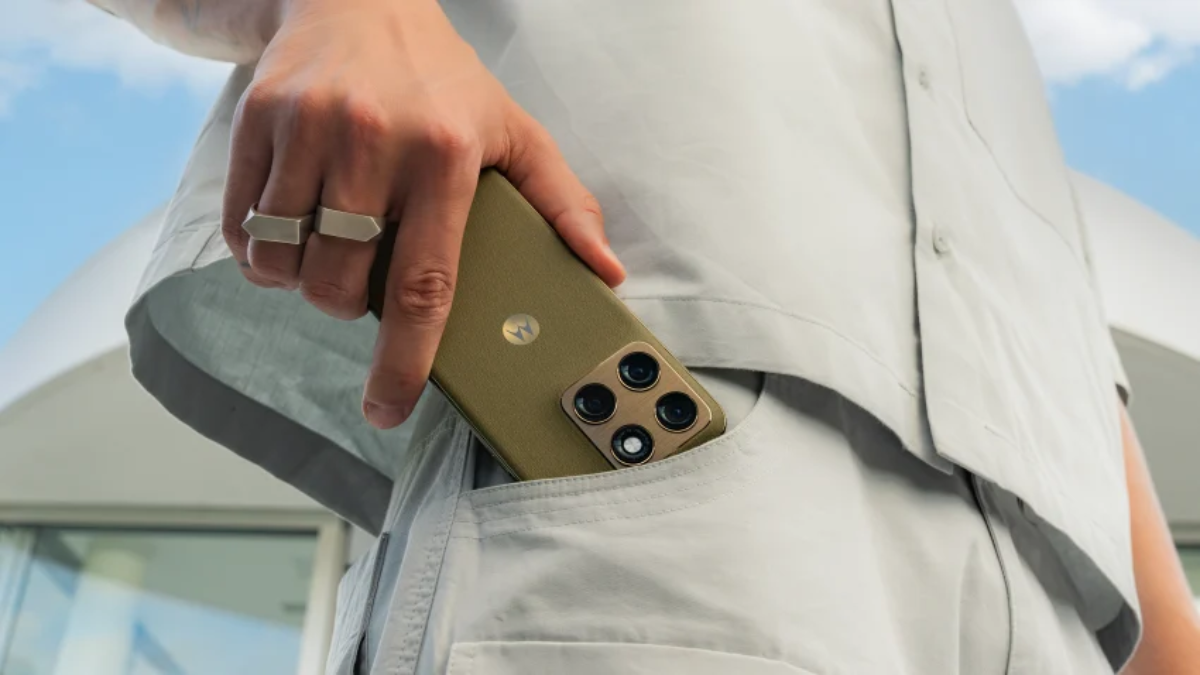
Motorola has continued its exclusive partnership with the color authorities at Pantone, and for 2026, they have made a bold stylistic choice. The Edge is available in only a single colorway: Pantone Martini Olive.
                     COLORWAY PROFILE: MARTINI OLIVE

   [ Matte Glass Finish ] ──► Resists smudges & fingerprint oils.
  ─────────────────────────────────────────────────────────────────
   [ Tonal Identity ]     ──► Rich, understated army green-esque hue.
   [ Target Audience ]    ──► Professional, utilitarian, premium look.
This color can be best described as a sophisticated, muted, army green-esque hue with subtle golden undertones that shift under direct sunlight. It is an understated, utilitarian aesthetic that feels premium without relying on loud, iridescent gradients. The matte coating does an excellent job of resisting oily fingerprint smudges, though the single-color strategy is a gamble; consumers who prefer classic minimalist tones like slate gray or porcelain white are left entirely out in the cold.
The Display Dilemma — Smaller Footprint, Maximum Luminescence
Perhaps the most shocking change to the 2026 Motorola Edge is its radical screen downsizing. In an industry where displays consistently trend larger every generation, Motorola has pulled a complete u-turn.
                  THE GENERATIONAL DISPLAY PIVOT

  [ Motorola Edge (2025) ] ──► 6.7-Inch Panel ──► 4,500 Nits Peak Brightness

  [ Motorola Edge (2026) ] ──► 6.3-Inch Panel ──► 5,200 Nits Peak Brightness
The Shrinking Screen Real Estate
The 2025 Edge featured an expansive, multimedia-friendly 6.7-inch display. The 2026 model shrinks that down to a much more compact 6.3-inch panel.
This sizing decision will completely divide the user base. For fans of single-handed usability, compact pocketability, and ergonomic comfort, the 6.3-inch form factor is an absolute dream. It is incredibly easy to reach the upper corners of the user interface without executing complex hand gymnastics.
On the flip side, for mobile gamers and hardcore media consumers who treat their smartphones as portable movie theaters, this downsizing feels like a distinct demotion.
Breaking Brightness Barriers: 5,200 Nits
While the screen size has shrunk, the underlying panel technology has received a massive technological upgrade. The 2026 Edge boasts a spectacular peak brightness of 5,200 nits, up from the already bright 4,500 nits of its predecessor.
A peak brightness of 5,200 nits is not just a marketing flex; it fundamentally transforms the outdoor usability of the device. Under intense, direct midday sunlight, where most mid-range smartphone screens wash out and turn into unreadable mirrors, the 2026 Edge cuts through glare with ease. Text remains razor-sharp, maps are perfectly legible, and high-dynamic-range (HDR10+) video content retains its punchy contrast and vibrant color mapping.
Resolution and Refresh Rate Optimization
The phone continues to offer a fluid 120Hz refresh rate, ensuring that system animations, scrolling feeds, and supported mobile games look buttery smooth. Because the physical screen size decreased, Motorola adjusted the native resolution slightly to maintain pixel density, moving from 2,712 by 1,220 pixels in 2025 down to 2,640 by 1,216 pixels in 2026.
                    DISPLAY RESOLUTION SPECS

  [ 2025 Model ] ──► 2,712 x 1,220 pixels (6.7" footprint)
  [ 2026 Model ] ──► 2,640 x 1,216 pixels (6.3" footprint)
  [ Net Result ] ──► Perceptual sharpness remains completely identical.
This pixel drop is entirely negligible to the naked human eye. The pixel-per-inch density remains high, ensuring that fine text displays zero jagged edges and images look incredibly clean.
Performance and Storage — A Disappointing Trade-Off
Under the hood, the performance profile of the 2026 Motorola Edge presents a classic tech narrative: incremental processing gains matched with a highly frustrating architectural limitation.
Inside the MediaTek Dimensity 7450
Powering the device is the newly minted MediaTek Dimensity 7450 processor, a direct step up from the Dimensity 7400 chip found in the outgoing model. Paired with 8GB of speedy LPDDR5X memory, this processing configuration handles daily productivity tasks effortlessly.
Multitasking between memory-heavy applications like Google Maps, Slack, and intensive web browsers is smooth and responsive. System resource management is aggressive, keeping frequently used apps frozen in the background without causing system stuttering or unexpected app closures when you switch back to them.
                  PROCESSING PERFORMANCE PROFILE

  [ Daily Tasks ]     ──► Social media, browsing, and messaging operate flawlessly.
  [ Thermal Control ] ──► Dimensity 7450 runs cool during extensive 4K video recording.
  [ Extreme Gaming ]  ──► Frames drop slightly on maximum graphical settings in heavy 3D titles.
However, it is vital to remember that the Dimensity 7450 is a mid-tier silicon layout, not a tier-one flagship processor like Qualcomm’s Snapdragon 8 series. While it handles everyday workloads smoothly, mobile enthusiasts trying to play demanding 3D games at maximum graphical settings will notice occasional frame drops during long gaming sessions.
The Storage Controversy: Stuck at 128GB
While the processor received a welcome upgrade, Motorola made a highly controversial decision regarding the phone’s storage configuration:
The 128GB Storage Cap: The 2026 Motorola Edge is available exclusively in a 128GB storage configuration. The 256GB storage option that was widely available on the 2025 model has been completely removed.
In 2026, capping a $600 “near-flagship” phone at 128GB of non-expandable storage is a massive misstep. A modern mobile operating system easily consumes 20GB to 30GB of space right out of the box for system files and cached data. Once a user downloads a handful of large mobile games, syncs offline Spotify playlists, and downloads a few high-resolution movies for travel, that 128GB ceiling approaches incredibly fast.
                    THE 128GB STORAGE CEILING

  [ OS & System Files ] ──► ~25GB (Mandatory baseline)
  [ Apps & Heavy Games ]──► ~40GB (Varies by user)
  [ Left for Media ]    ──► ~63GB (Quickly consumed by 4K video recording)
Because the phone features an upgraded 50MP camera system capable of shooting high-bitrate 4K video, users who enjoy capturing daily video content will find themselves constantly managing local files or being forced to pay for monthly cloud storage subscriptions. For a phone that saw a $50 price increase, removing the higher storage tier is a bitter pill for consumers to swallow.
Camera Breakthroughs — Sony LYTIA Hardwired with Clever Software
Motorola has historically struggled to match the photographic processing power of Google, Apple, or Samsung. However, with the 2026 Edge, they have made significant strides by combining a superior hardware sensor from Sony with highly practical, user-focused software engineering.
                   TRIPLE 50MP REAR CAMERA TOPOGRAPHY

  [ Main Camera ]     ──► 50MP ──► Sony LYTIA 710 Sensor (Massive Low-Light Leap)
  [ Ultrawide Lens ]  ──► 50MP ──► 122° Field of View + Macro Vision
  [ Telephoto Lens ]  ──► 10MP ──► 3x Optical Zoom / 30x Digital Zoom
The Main Sensor: Sony LYTIA 710
The primary shooter remains a 50MP camera, but the core sensor has been upgraded to the Sony LYTIA 710, stepping up from the previous generation’s Sony LYT700C. This is a crucial hardware update. The LYTIA 710 architecture is engineered to maximize light intake while drastically lowering image noise.
In real-world testing, this new sensor shines brightest during low-light and night-time photography:
-
Night Mode Processing: The LYTIA 710 captures low-light scenes with impressive clarity, preserving fine details in dark shadows without blowing out artificial light sources like neon signs or street lamps.
-
Color Accuracy: Skin tones look natural, and the typical over-saturation errors that plagued older Motorola cameras have been noticeably reined in.
Supporting Lenses: Ultrawide, Telephoto, and Selfies
The surrounding camera array remains versatile and highly competitive:
-
50MP Ultrawide Camera: Delivers an expansive 122-degree field of view for dramatic landscape photography. It also houses Motorola’s Macro Vision system, which allows the lens to lock focus just millimeters away from a subject, capturing spectacular close-up textures, intricate insect details, or jewelry.
-
10MP Telephoto Camera: Offers a true 3x optical zoom and up to 30x digital zoom. The 3x optical focal length is perfect for capturing flattering portrait shots, providing natural background separation (bokeh) without relying entirely on artificial software blurring.
-
50MP Front Selfie Camera: Motorola promises sharper contrast and better highlight control from the front camera this year, making it a great option for high-res video calling and content creation.
The Software Highlight: Frame Match
The most innovative addition to the 2026 Edge isn’t a piece of camera hardware; it’s an incredibly practical software feature called Frame Match. We have all experienced the frustration of handing our smartphone to a friend or a helpful stranger to take a group photo, only to get the phone back and discover they completely cut off the landmark behind you or framed the shot terribly.
                        HOW FRAME MATCH WORKS

  [ 1. Frame the Shot ]     ──► You line up the background exactly how you want it.
  [ 2. Lock the Template ]  ──► Activating Frame Match overlays a transparent guide.
  [ 3. Hand over Phone ]    ──► The stranger simply aligns the camera with the guide.
  [ 4. Perfect Result ]     ──► The final photo matches your exact vision.
Frame Match solves this common problem with an elegant workflow:
-
You stand in the exact spot where the photo will be taken and frame the background composition perfectly.
-
You lock in your desired composition. This saves a semi-transparent, ghosted outline of the background landscape directly on the live viewfinder screen.
-
You hand the smartphone to the substitute photographer.
-
All they have to do is match up the physical background with the transparent guide on the display and hit the shutter button.
This simple tool completely eliminates bad framing, ensuring you get the exact travel photo or group portrait you envisioned every single time.
Battery Endurance — Smaller Tank, More Efficient Engine
When evaluating an ultra-thin smartphone, battery endurance is always the primary concern. To shrink a phone down to a razor-thin 0.28 inches, engineers are physically forced to reduce the size of the battery pouch inside.
                 BATTERY CAPACITY COMPARISON

  [ 2025 Model ] ──► 5,200mAh Power Cell
  [ 2026 Model ] ──► 5,000mAh Power Cell
The 2026 Motorola Edge takes a structural step down to a 5,000mAh battery, dropping from the 5,200mAh battery found in the 2025 model. On paper, losing 200mAh of battery capacity while the retail price goes up can feel like a step backward.
Motorola’s 2-Day Battery Claim Under the Microscope
Despite the smaller physical battery size, Motorola claims that the 2026 Edge can last up to two days on a single charge. While this sounds like corporate hyperbole, real-world battery performance is surprisingly strong due to three key factors:
-
The Smaller 6.3-inch Footprint: Driving pixels across a 6.3-inch screen consumes significantly less power than keeping a massive 6.7-inch display illuminated.
-
Silicon Efficiency: The MediaTek Dimensity 7450 processor is built on an incredibly efficient architectural node, optimizing power draw during idle states and background tasks.
-
Software Optimization: Motorola’s near-stock Android user interface lacks the heavy, battery-draining software skins used by some of its competitors.
In standard real-world use—including web browsing, streaming music over Bluetooth, responding to emails, and watching an hour of YouTube video—the 2026 Edge easily sails through a full day of heavy use, leaving roughly 40% to 45% of power in reserve at bedtime.
For light users who don’t push their phones hard, reaching that elusive two-day mark without visiting a charging brick is entirely possible. It turns out that while the fuel tank got slightly smaller, the engine became much more efficient.
Final Verdict — Weighing the Upgrades Against the Downgrades
The 2026 Motorola Edge is a fascinating, highly focused smartphone that prioritizes daily design comfort and real-world utility over raw specification sheet dominance. Motorola has crafted a device that punches well above its weight class in terms of looks and brightness, but it forces buyers to accept a few undeniable pain points.
The Competitive Breakdown: Pros vs. Cons
The Pros
-
Ultra-Thin Luxury Design: At just 0.28 inches thick, it brings an incredibly premium, sleek hand-feel to a much lower price point than its thousand-dollar competitors.
-
Blindingly Bright Display: The 5,200-nit peak brightness panel completely eliminates outdoor readability issues under direct sunlight.
-
Sony LYTIA Camera Upgrade: The upgraded main sensor delivers cleaner low-light photos and richer night-time detail.
-
Innovative Software: Features like Frame Match solve real-world, daily photo frustrations with an elegant, easy-to-use interface.
-
Impressive Power Optimization: The smaller 5,000mAh battery still delivers true all-day endurance and approaches two days of use for lighter workloads.
The Cons
-
Frustrating Storage Limitation: Capping the device exclusively at 128GB of non-expandable storage in 2026 is a major limitation for power users and content creators.
-
Generational Price Hike: The retail price has climbed by $50 to $599.99, putting it under much closer scrutiny.
-
Polarizing Screen Downsize: Shifting from a large 6.7-inch display to a compact 6.3-inch panel will disappoint fans of large-screen media consumption.
-
Single Colorway Strategy: Offering the device exclusively in Pantone Martini Olive leaves no options for buyers who prefer classic black, white, or gray tones.
Buying Guide — Is the 2026 Motorola Edge Right for You?
                        DECISION FLOWCHART

  Do you want a thin, lightweight phone with a brilliant screen? ──► YES
                               │
                               ▼
  Do you need more than 128GB of internal local storage?          ──► YES ──► Look Elsewhere
                               │
                               ▼ NO

                     [ BUY THE MOTOROLA EDGE ]
Who Should Buy It?
The 2026 Motorola Edge is an excellent choice for the everyday user who values ergonomics, style, and daylight display performance above all else. If you are tired of carrying heavy, bulky smartphones that stretch your pockets, the 0.28-inch chassis and compact 6.3-inch screen will feel like a breath of fresh air.
It is also an incredibly compelling option for budget-conscious buyers who want the ultra-thin look of the $1,100 iPhone Air or Galaxy S25 Edge but want to save a massive $500 in the process.
Who Should Avoid It?
If you are a mobile power user who shoots hours of 4K video, downloads massive files, or plans to keep your phone for the next four to five years without running out of local space, the 128GB storage limit is an immediate dealbreaker.
Similarly, if you rely on your phone as your primary entertainment screen for movies and cloud gaming, you will likely be happier looking at remaining stock of last year’s 6.7-inch model or exploring alternative devices that haven’t downsized their displays.
Motorola has taken a calculated gamble with the 2026 Edge. By pairing high-end design elements with targeted hardware updates, they have built a genuinely beautiful phone. If you can live within the boundaries of its 128GB storage ceiling, it stands as one of the most stylish and practical near-flagship options available this season.
FAQ Schema Content
What is the price of the Motorola Edge 2026?
The Motorola Edge 2026 starts at $599.99, making it a near-flagship smartphone that offers premium design features at a lower price than many flagship competitors.
How thin is the Motorola Edge 2026?
The Motorola Edge 2026 features an ultra-thin chassis measuring just 0.28 inches thick, making it one of Motorola’s slimmest smartphones to date.
Does the Motorola Edge 2026 have a good camera?
Yes. The phone features a 50MP Sony LYTIA 710 main camera, a 50MP ultrawide camera, and a 10MP telephoto lens with 3x optical zoom, delivering strong photo quality, especially in low-light conditions.
What is Frame Match on the Motorola Edge 2026?
Frame Match is a camera feature that allows users to save a photo composition template, helping another person recreate the exact framing when taking a picture.
How bright is the Motorola Edge 2026 display?
The Motorola Edge 2026 offers a peak brightness of 5,200 nits, providing excellent visibility even under direct sunlight.
What processor powers the Motorola Edge 2026?
The smartphone is powered by the MediaTek Dimensity 7450 chipset paired with 8GB of RAM for smooth daily performance and multitasking.
How much storage does the Motorola Edge 2026 have?
The Motorola Edge 2026 is available only with 128GB of internal storage, which may be limiting for users who store large amounts of media or record extensive 4K video.
How long does the Motorola Edge 2026 battery last?
The phone includes a 5,000mAh battery and can easily last a full day of heavy usage, with lighter users potentially reaching up to two days on a single charge.
Is the Motorola Edge 2026 good for gaming?
The device handles most mobile games smoothly, but demanding 3D titles running at maximum graphics settings may experience occasional frame drops.
Should you buy the Motorola Edge 2026?
The Motorola Edge 2026 is a great choice for users seeking a stylish, lightweight, ultra-thin smartphone with a bright display and capable cameras. However, users needing more than 128GB of storage may want to consider alternatives.