
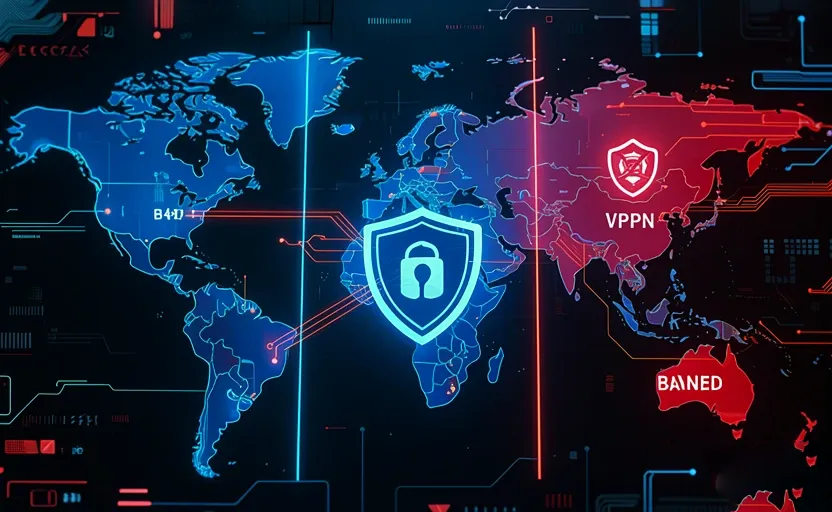
While the majority of the world treats Virtual Private Networks (VPNs) as essential digital armor for corporate data and personal privacy, a growing number of jurisdictions view them as tools for circumventing state-level censorship, tracking, and content controls.
Understanding where you can safely use a VPN requires breaking down the world into three distinct regulatory categories: Fully Unrestricted, Restricted/State-Sanctioned, and Completely Prohibited.
Clear Skies: Where VPNs Are Fully Legal and Encouraged
In these jurisdictions, a VPN is legally recognized as a standard security protocol—identical to locking your front door at night. In fact, industries handling sensitive user data (like healthcare or financial technology) are frequently mandated under privacy laws to route their remote connections through VPN networks.
-
United States & Canada: Fully legal. There are zero consumer restrictions on traffic encryption. However, note that while using a VPN is legal, it does not grant immunity for illegal acts committed behind it.
-
The European Union: Deeply protected under privacy regulations like the GDPR. Using encryption to mask personal data is actively supported.
-
United Kingdom, Australia, & Japan: Legally sound for consumer and corporate privacy alike.
The Gray Zone: Conditional or State-Sanctioned Legality
These countries operate on a “regulated use” model. Instead of banning the technology entirely, the state permits VPN use only if the providers compromise their main selling point: absolute privacy.
| Country | Legal Status | Operational Context |
| China | Restricted | Only government-approved VPNs are legal. These services must route traffic through state-monitored gateways, rendering them ineffective for bypassing the Great Firewall. Unauthorized VPN use can result in fines. |
| Russia | Restricted | VPN services are legally required to log user data and block state-banned content. Independent, non-compliant VPN providers have their local servers or app access heavily blocked via advanced traffic filtering. |
| India | Legal (with data mandates) | End-user VPN consumption is completely legal. However, a local mandate requires any provider maintaining physical infrastructure in India to store subscriber identifiers and activity logs for five years. |
| UAE | Conditional | Using a VPN for corporate networks or personal security is perfectly legal. However, using a VPN to commit a digital crime, bypass state-blocked communication apps (VoIP), or access forbidden content carries massive structural fines. |
The Blacklist: Countries Where Using a VPN is Illegal
If you operate or travel through these nations, deploying an unauthorized VPN tunnel directly violates federal law and can expose you to state surveillance, steep fines, or custodial prison sentences.
-
North Korea: Completely banned. The global internet is blocked for the general public, who instead rely on a heavily curated national intranet (Kwangmyong). Attempting to use any circumvention tool is treated as a severe security violation.
-
Belarus: Banned since 2015. The state explicitly outlaws anonymization tools, including VPNs and Tor networks, to tightly regulate domestic communication channels.
-
Turkmenistan: Strictly forbidden. The single state-run ISP enforces a blanket ban on VPN architecture, and reports indicate citizens are occasionally required to pledge non-use.
-
Iraq: A total blanket ban initiated in 2014 remains strictly in place, with no carve-outs for personal privacy or independent NGOs.
Terms of Service (ToS) vs. Criminal Law
A frequent point of confusion is using a VPN to unblock region-restricted catalogs on streaming platforms like Netflix or Disney+.
The distinction is simple: You are not breaking federal criminal laws by doing this in a country where VPNs are legal, but you are breaking a private contract (the platform’s Terms of Service). The platform reserves the right to block your VPN’s IP address or terminate your streaming account, but you will not face legal prosecution.
FAQ
1. What is a VPN and why do people use it?
A Virtual Private Network (VPN) is a technology that encrypts internet traffic and routes it through a secure server, helping protect personal data, hide IP addresses, secure remote work connections, and improve online privacy. Businesses commonly use VPNs to safeguard sensitive information, while individuals use them to enhance security on public networks and reduce tracking.
2. Are VPNs legal in most countries?
Yes. In the majority of countries, VPNs are completely legal and widely used for cybersecurity, privacy protection, and remote access to corporate networks. Nations such as the United States, Canada, most European Union member states, the United Kingdom, Australia, and Japan generally permit unrestricted VPN usage.
3. Does using a VPN make online activities legal?
No. A VPN only encrypts and redirects internet traffic. It does not provide legal immunity. Activities that are illegal without a VPN remain illegal when performed through a VPN connection.
4. Which countries fully allow VPN usage?
Countries with generally unrestricted VPN use include:
- United States
- Canada
- European Union member states
- United Kingdom
- Australia
- Japan
In these regions, VPNs are commonly used by consumers, businesses, healthcare providers, and financial institutions.
5. Why do some governments restrict VPN services?
Certain governments view VPNs as tools that can bypass censorship systems, surveillance frameworks, content restrictions, or internet controls. As a result, they may regulate, monitor, or restrict VPN providers operating within their jurisdictions.
6. How does China regulate VPNs?
China permits only government-approved VPN services. Unauthorized VPN providers may be blocked, and individuals or businesses using unapproved services may face penalties. Approved VPNs typically operate under state regulatory requirements and monitoring obligations.
7. What are the VPN regulations in Russia?
Russia requires VPN providers to comply with state regulations, including blocking access to prohibited content and following local compliance requirements. Non-compliant services often experience technical blocking or access restrictions.
8. Is using a VPN legal in India?
Yes. VPN use by individuals is legal in India. However, providers maintaining infrastructure within India may be subject to data retention and regulatory compliance requirements established by local authorities.
9. Can VPNs be used legally in the United Arab Emirates (UAE)?
Yes. VPNs can be legally used for business operations, corporate networks, and personal cybersecurity. However, using a VPN to commit offenses, access prohibited services, or violate local regulations may result in severe penalties.
10. Which countries prohibit VPN usage?
Countries often cited as having strict prohibitions or severe restrictions on unauthorized VPN usage include:
- North Korea
- Belarus
- Turkmenistan
- Iraq
Travelers should always verify current regulations before visiting these jurisdictions.
11. Can tourists use VPNs while traveling?
It depends on local laws. In countries where VPNs are unrestricted, tourists generally face no issues. In countries with restrictions or bans, using unauthorized VPN services could lead to fines, device inspections, or legal consequences.
12. Is it illegal to use a VPN for streaming content from another region?
In most countries where VPNs are legal, this is generally not a criminal offense. However, it may violate the streaming platform’s Terms of Service (ToS). Companies may block VPN traffic, restrict access, or suspend accounts.
13. What is the difference between violating Terms of Service and breaking the law?
Breaking a Terms of Service agreement is a contractual issue between the user and the platform. Breaking a law involves violating government regulations and may result in legal penalties. The two are not necessarily the same.
14. Can a VPN guarantee complete anonymity online?
No. VPNs improve privacy but do not guarantee complete anonymity. Factors such as browser fingerprinting, account logins, malware, tracking cookies, and provider logging policies can still reveal user activity.
15. Are business VPNs treated differently from personal VPNs?
In many jurisdictions, business VPNs are considered critical cybersecurity infrastructure and are often explicitly permitted even where consumer VPN use faces restrictions. However, regulations vary by country.
16. How can travelers determine whether a VPN is legal in their destination?
Before traveling:
- Review official government guidance.
- Check embassy or consular advisories.
- Consult reputable cybersecurity resources.
- Verify whether the VPN provider operates legally within the destination country.
17. What risks exist when using a VPN in a restricted country?
Potential risks include:
- Financial penalties
- Account monitoring
- Service blocking
- Device inspections
- Legal prosecution in severe cases
The severity depends on local laws and enforcement practices.
18. Are free VPN services safe?
Not always. Some free VPN providers monetize user data, inject advertisements, or maintain weak security practices. Users should carefully evaluate privacy policies, security standards, and company reputation before using any VPN service.
19. Why do companies require VPN connections?
Organizations use VPNs to:
- Protect confidential business information
- Secure remote employees
- Encrypt data transmissions
- Reduce cybersecurity risks
- Meet regulatory compliance requirements
20. What is the safest approach to VPN usage internationally?
Use reputable VPN providers, understand local laws before traveling, avoid assuming VPN use is universally permitted, and remember that encryption tools do not override legal responsibilities.