
Samsung Is Preparing a Brand-New Foldable Phone Variant: 7.6-Inch Screen with a 4:3 Ratio
1 month ago · Updated 1 month ago
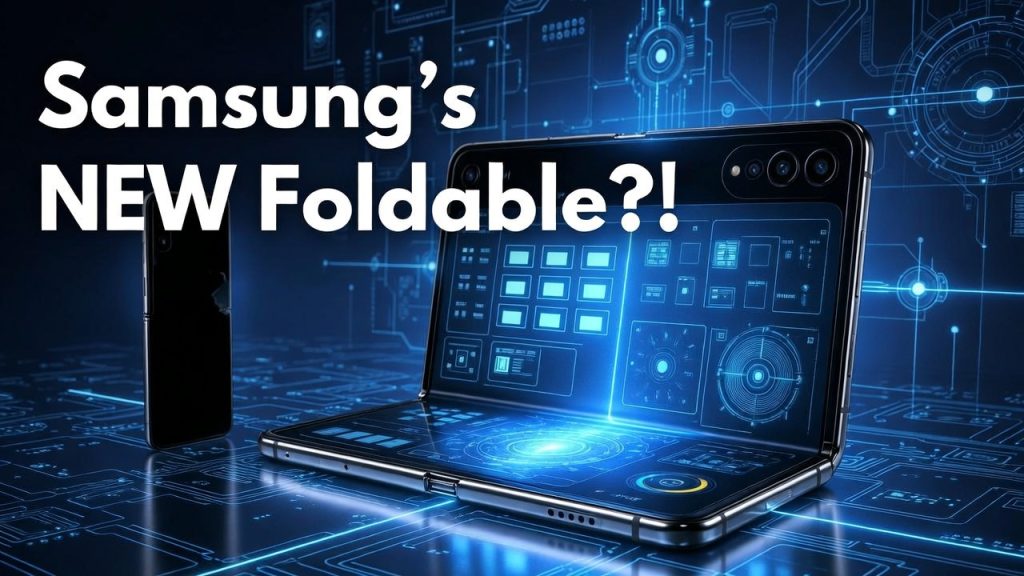
Samsung has dominated the premium foldable smartphone market since the first Galaxy Z Fold launched in 2019, establishing the book-style foldable as the dominant form factor for large-screen folding phones. Six generations of Galaxy Z Fold devices have followed the same fundamental design language: a tall, narrow phone when folded, opening into a roughly square-ish inner display with an aspect ratio in the neighborhood of 6:5 or 22.5:18 approximately tablet-shaped but still distinctly taller than wide. This design has proven commercially successful, and Samsung has refined it across six generations without fundamentally questioning its proportions.
Now, according to a leak from one of the most reliable leakers in the Asian smartphone market, Samsung is about to question exactly those proportions. Digital Chat Station (DCS), the Weibo-based leaker with an established track record for accurate Samsung information, has reported that Samsung is preparing an entirely new foldable variant — not a successor to the Galaxy Z Fold8 but a genuinely new product category with a fundamentally different form factor.
The distinguishing characteristic is the aspect ratio. While the Galaxy Z Fold series uses a tall, narrow inner display, the new variant is described as having an inner display with a 4:3 aspect ratio the classic "four-thirds" proportion that has defined tablets for decades, from the original iPad to modern iPad Pros. The inner screen size remains the same 7.6 inches as the Galaxy Z Fold8, but distributing those 7.6 inches across a wider, shorter rectangle produces a device that, when open, genuinely looks and feels like a small tablet rather than a large phone.
This article examines the full implications of this design shift: what a 4:3 aspect ratio means for the user experience, how the wider cover screen changes everyday phone use, what the Snapdragon 8 Elite Gen 5 and dual-cell battery configuration tell us about the device’s positioning, whether this is a global product or a South Korea-first experiment, and what this new variant means for Samsung’s foldable strategy and the broader competitive landscape.
📋 Leaked Specs at a Glance: Source: Digital Chat Station (DCS) via Weibo / Gizmochina • Inner screen: 7.6 inches (same as Z Fold8) • Aspect ratio: 4:3 (wider, shorter — tablet-like) • Cover screen: Wider than current Z Fold • Chipset: Snapdragon 8 Elite Gen 5 (latest Qualcomm flagship) • Battery: ~4800mAh dual-cell (2,267mAh + 2,393mAh) • Launch market: South Korea first, global availability unconfirmed • Positioning: New product line, not a Z Fold8 replacement
Understanding the 4:3 Aspect Ratio: What It Actually Means
The aspect ratio of a screen is the mathematical relationship between its width and height. A 4:3 aspect ratio means the screen is four units wide for every three units tall — a 12-inch screen in 4:3 would be about 9.6 inches wide and 7.2 inches tall. This is the same ratio as an original iPad screen, most classic computer monitors from before widescreen became standard, and the 35mm film frame that defined cinema for decades.
How 4:3 Compares to Current Foldable Aspect Ratios
Current foldable phones, when opened, typically use inner display aspect ratios that are approximately square or slightly taller than wide. The Galaxy Z Fold7’s inner display has an aspect ratio of approximately 23:18 — still slightly taller than wide, but closer to square than to a conventional phone’s widescreen aspect ratio. Google’s Pixel 9 Pro Fold uses a 6:5 inner ratio. Huawei’s Mate X3 uses something close to 7:8 (slightly wider than tall). OnePlus Open uses approximately 7:6.
The 4:3 ratio proposed for Samsung’s new variant is notably wider relative to height than any of these competitors. At 7.6 inches diagonal with a 4:3 ratio, the screen would be approximately 6.1 inches wide and 4.6 inches tall — markedly shorter and wider than the current Z Fold. For comparison, the Z Fold7’s approximately 7.6-inch inner display at its aspect ratio is roughly 6.2 inches wide and 5.4 inches tall. The new variant would be about the same width but nearly an inch shorter in height — a significant change that fundamentally alters the device’s feel in the hand and its utility for various tasks.

Figure 2: Aspect ratio comparison across the foldable phone market. From left to right: Galaxy Z Fold7 (approximately 23:18), Google Pixel 9 Pro Fold (6:5), OnePlus Open (approximately 7:6), Huawei Mate X3 (approximately 7:8), and the rumored Samsung new variant (4:3). The progression toward wider, shorter displays reflects different design philosophies about what a foldable phone should be when open — the 4:3 ratio is the most tablet-like of the major options and represents the biggest departure from conventional phone proportions. All displays approximately 7.6 inches diagonal. (Image credit: Nesabamedia / Illustration)
Why 4:3 Makes a Display Feel Like a Tablet
The 4:3 ratio creates a tablet-like visual experience for a specific psychological and practical reason: it is the ratio of virtually every consumer tablet product that has shaped how we think about tablet computing. The original iPad (2010) used a 4:3 display. The iPad mini uses 4:3. The iPad Air uses 4:3. Amazon’s Kindle Fire tablets use 4:3. For most users, a screen in the 4:3 ratio at approximately 7 inches or larger immediately reads as "tablet" regardless of the device it is attached to.
This perceptual mapping is not merely aesthetic — it has practical implications for how users approach the device. A 4:3 screen at 7.6 inches diagonal presents content with proportions that users have learned to navigate on tablets. E-books display in a ratio close to a printed page. Websites formatted for tablet browsing display with appropriate proportions. Video calls display faces at a scale and aspect that feels natural for face-to-face communication. Standard-definition and older video content that was mastered in 4:3 displays without letterboxing.
The User Experience Benefits of a 4:3 Foldable
The choice of a 4:3 aspect ratio is not arbitrary — it is optimized for a specific set of use cases that Samsung is betting will be compelling enough to justify a new product category. Understanding these use cases helps evaluate whether the 4:3 foldable addresses real user needs or is primarily a differentiation exercise.
Reading: The Book Page Proportion
Reading is arguably the strongest use case for a 4:3 display in a foldable phone. The aspect ratio of a standard book page in portrait orientation is very close to 4:3 (or its portrait equivalent, 3:4). A 7.6-inch screen in 4:3 displays an e-book page with proportions that closely approximate a physical book page, showing more content per screen than a taller, narrower display would in the same page layout.
On the Galaxy Z Fold’s approximately 23:18 inner display, e-book applications typically present a page that is comfortable to read but somewhat more square than a book page, requiring slight mental adjustment. On a 4:3 display, the page layout is essentially perfect: the proportions match what the human eye has been trained to expect from printed material over decades. For users who read extensively — novels, technical documents, academic papers, news articles in e-reader format — this difference is immediately noticeable and meaningful.
The same logic applies to reading PDFs and document formats, which are typically formatted for A4 or Letter paper sizes. These formats have an aspect ratio close to √2:1 or approximately 5:4 in portrait orientation — closer to 4:3 than to the widescreen ratios of conventional phones. Documents displayed on a 4:3 screen in portrait mode require less zooming and scrolling to read comfortably than the same documents on a widescreen device.
Video Viewing: A Different Compromise
Video viewing on a 4:3 device is a more nuanced story. Modern video content — YouTube, Netflix, Disney+, most streaming services — is mastered in 16:9 widescreen or, for theatrical content, even wider aspect ratios like 2.35:1. Displaying 16:9 content on a 4:3 screen requires either letterboxing (black bars at top and bottom of the content) or cropping (displaying only the center portion of the wide frame).
At 7.6 inches with letterboxing, 16:9 content would display at an effective width of approximately 6.1 inches with black bars — meaning the actual video content would appear at a slightly smaller scale than it would on a screen already in 16:9 format. However, the overall viewing experience on a 7.6-inch screen is still significantly better than on a conventional phone screen (typically 6.1 to 6.9 inches), even with letterboxing, because of the larger overall display area.
Conversely, video content mastered for 4:3 or square ratios — including a significant portion of TikTok content (which is 9:16 in portrait but can be displayed at full width in landscape 4:3 with minimal letterboxing), classic television in 4:3, and video calls where the square-ish facial framing of most camera applications fits naturally into a 4:3 container — displays excellently on the new format. For users who consume social media video and video calls more than long-form streaming content, the 4:3 display may actually be superior.
Multitasking: The Side-by-Side Advantage
Samsung One UI’s multi-window support allows displaying two applications simultaneously side-by-side on the inner display of foldable phones. On a 4:3 display, this side-by-side multitasking takes on different proportions than on the taller Galaxy Z Fold displays. With a wider, shorter screen, two applications placed side-by-side each receive a window that is approximately 3:4 in its orientation — portrait-shaped, which is the natural orientation for most mobile applications.
This is a meaningful improvement over the Z Fold’s multitasking layout. On the Z Fold’s inner display, two applications side-by-side each receive windows that are quite narrow in proportion — approximately half the screen width, which on a 23:18 screen produces windows that are quite tall and narrow, forcing applications to use compressed mobile layouts or to scroll extensively. The wider 4:3 screen distributes the available space differently: each half is more square, allowing applications to display in comfortable tablet-style layouts.
For productivity use cases — working in a document while referencing a webpage, keeping a calendar visible while in an email application, browsing while messaging — the wider side-by-side layout of the 4:3 screen is genuinely more functional than what the current Z Fold offers. Samsung has invested significantly in DeX (its desktop extension technology) and productive multitasking as differentiating features; the 4:3 foldable would amplify these features’ utility.
Photography: The Landscape Frame Advantage
A wider, shorter display presents photographs in landscape orientation more naturally than a tall display. When reviewing landscape photographs on the Galaxy Z Fold, the tall inner display displays landscape photos with significant black bars unless the user rotates the phone. On a 4:3 display, landscape photographs display at close to full screen in landscape orientation, creating a viewing experience more like a digital photo frame or tablet photo viewer.
This applies not just to photo review but to photography composition: using the inner display as a viewfinder in landscape orientation provides a wider, more representative view of the scene being composed. For photography-focused users who use their foldable as a more expansive viewfinder for careful composition, the 4:3 inner display in landscape orientation is more useful than the taller Z Fold display.
📱 Best Use Cases for the 4:3 Foldable: Reading e-books and documents (book page proportions) • Video calls (natural face framing in 4:3) • Social media (TikTok, Instagram Reels fit better) • Side-by-side multitasking (each window gets portrait-friendly proportions) • Landscape photography review • Tablet apps designed for 4:3 iPad-like display • Standard-definition and classic TV content
The Wider Cover Screen: Transforming the Folded Experience
A foldable phone’s cover screen — the external display visible when the device is folded — is equally important as the inner display for daily usability. For many users, the majority of their quick interactions with a foldable phone happen on the cover screen: checking notifications, sending brief messages, reading incoming texts, checking the time, and handling quick tasks that do not justify opening the device.
The Current Galaxy Z Fold Cover Screen Problem
The Galaxy Z Fold series has historically faced criticism for its cover screen proportions. Because the device folds at the halfway point of its tall inner display, the cover screen inherits the narrow aspect ratio of half the inner display — resulting in a cover screen that is notably tall and narrow, with an aspect ratio around 23:9 in some configurations. This very narrow cover screen is awkward for typing: the keyboard is compressed to a narrow band that requires precise thumb placement and limits typing comfort.
Samsung addressed this somewhat in the Z Fold6 by widening the cover screen slightly and improving the overall ergonomics. But the fundamental constraint remains: a tall, narrow foldable produces a tall, narrow cover screen. The new 4:3 foldable, being wider relative to its height, naturally produces a cover screen with a better aspect ratio for everyday use.
How a Wider Cover Screen Changes Typing and Messaging
The leaker DCS specifically notes that the wider cover screen of the 4:3 foldable will be "more comfortable for typing and messaging." This prediction is mechanically sound. A wider cover screen provides more horizontal space for a keyboard, allowing the keyboard layout to be closer to the proportions of a tablet keyboard on a compact screen. The keys can be larger relative to the screen width, reducing missed keystrokes and improving typing speed for thumb typists.
For users who rely on their foldable phone for messaging throughout the day, the cover screen typing experience is one of the most frequently encountered interactions. Improvements here have outsized impact on overall device satisfaction. The Samsung Galaxy Z Fold series has long been somewhat awkward for cover-screen typing compared to conventional rectangular phones precisely because of the narrow cover screen proportions. A wider cover screen directly addresses this weakness.
Beyond typing, a wider cover screen displays content — messages, notifications, social media previews, news headlines — with more horizontal room, reducing the need for text to truncate or wrap aggressively. The reading experience on the cover screen improves correspondingly.
The Folded Pocket Experience
When folded, the 4:3 foldable will be shorter and wider than the current Galaxy Z Fold series. This changes the device’s pocket and hand feel significantly. The current Z Fold, when folded, is a tall, narrow bar that sits vertically in a pocket like a conventional smartphone but thicker. The new 4:3 variant, when folded, would be shorter and wider — more like a small wallet or passport holder in profile.
Whether this folded form factor is better or worse in the pocket depends on the user’s clothing and preferences. The shorter device fits more naturally in a shirt pocket or a smaller pants pocket that cannot accommodate a tall phone. However, the wider folded device may feel bulkier in a jeans front pocket than the tall, narrow format, because width is the dimension that tends to press most noticeably against the leg when seated.
This is a design trade-off that Samsung will have navigated with prototype testing, and user reception will ultimately depend on individual preferences and carry habits. What is certain is that the change is significant: the 4:3 foldable will feel like a genuinely different object in the hand and pocket compared to the current Galaxy Z Fold.
Chipset: Snapdragon 8 Elite Gen 5 — What It Means
According to the DCS leak, the new 4:3 foldable will use the Snapdragon 8 Elite Gen 5, described as Qualcomm’s latest processor. This chipset placement is significant for what it tells us about Samsung’s positioning of the new device.
Flagship-Tier Performance
The Snapdragon 8 Elite series represents Qualcomm’s top-of-the-range mobile processor offering — the silicon that powers the most premium Android smartphones globally. Placing this chipset in the new foldable variant signals that Samsung intends this device to compete in the premium segment, not as an affordable or mid-range alternative to the Galaxy Z Fold series.
The DCS leak specifically notes that the new device will have "performance equivalent to the Galaxy Z Fold8 and Z Flip8 flagship lines planned for release this year." This is an important confirmation: the 4:3 foldable is not positioned as a lower-specced option at a lower price point, but as a flagship-grade product that will command a premium price while offering a different form factor rather than a different performance tier.
The Snapdragon 8 Elite Gen 5 is expected to bring improvements in CPU performance, GPU efficiency, AI processing capabilities, and camera ISP quality compared to its predecessors. For a foldable phone, the AI processing improvements are particularly relevant: Samsung’s Galaxy AI features — including Circle to Search, Live Translate, Note Assist, and other AI-powered features — benefit directly from the dedicated on-device AI processing that flagship Snapdragon chips provide.
Thermal Management in a Wider Chassis
A significant engineering challenge in foldable phones is thermal management — preventing the device from overheating under sustained load when the compact foldable chassis limits the physical space available for heat dissipation. The wider, shorter 4:3 chassis actually presents some potential thermal management advantages: the wider internal volume may allow for a larger vapor chamber or more extensive graphite cooling layers distributed across a wider area.
The Snapdragon 8 Elite series is designed with power efficiency as a priority, using Qualcomm’s Oryon CPU architecture that delivers high performance at lower power consumption than previous designs. This efficiency is doubly valuable in a foldable context where thermal constraints limit sustained performance.
Battery: Dual-Cell 4800mAh and What It Tells Us About Foldable Engineering
The leaked battery specification for the new 4:3 foldable — approximately 4800mAh total capacity in a dual-cell configuration (2,267mAh + 2,393mAh) — is both a practical specification and an insight into the engineering constraints of foldable phone design.
Why Foldable Phones Need Dual-Cell Batteries
A foldable phone’s hinge mechanism divides the device into two roughly equal panels that fold together. The internal volume of each panel must accommodate its share of the device’s components: display driver circuits, camera modules (in the panel containing the rear cameras), and crucially, the battery cells that power the device.
A single large rectangular battery cell — which is the format used in conventional rectangular smartphones — cannot easily fit into a foldable design because it cannot span the hinge and because its shape may not efficiently use the available volume in both panels. Dual-cell configurations place separate battery cells in each panel of the foldable device, allowing each cell to be shaped and sized to fit its panel’s available internal volume and distributing the total battery mass across both sides of the hinge.
The specific cell sizes in the leaked specification — 2,267mAh and 2,393mAh — are slightly asymmetric, with the larger cell presumably in the panel with fewer competing component space requirements. This asymmetry is typical in foldable battery design: perfectly equal cells are not always possible given the different component configurations in each panel.
4800mAh in Context
A 4800mAh total battery capacity is competitive for a premium foldable phone. For comparison, the Galaxy Z Fold7 uses a 4400mAh battery, the Google Pixel 9 Pro Fold uses a 4650mAh battery, and the OnePlus Open uses a 4805mAh battery. The 4800mAh figure for the new variant represents a meaningful improvement over the existing Z Fold7 and is broadly comparable to the competition.
The practical implication is that battery life should be a strength of the new device rather than a limitation. Foldable phones have historically been criticized for battery life because their large, high-refresh-rate inner displays consume significant power. A 4800mAh dual-cell battery, combined with the power efficiency of the Snapdragon 8 Elite Gen 5, should provide all-day battery life even under moderately demanding use including extended inner-display use.
| Device | Inner Screen | Aspect Ratio | Battery | Chipset (est.) |
| Samsung 4:3 New Variant (leaked) | 7.6 inches | 4:3 ★ (tablet-like) | ~4800mAh dual-cell ★ | Snapdragon 8 Elite Gen 5 |
| Samsung Galaxy Z Fold8 (expected) | 7.6 inches | ~23:18 (near-square) | ~4400mAh (est.) | Snapdragon 8 Elite Gen 5 |
| Samsung Galaxy Z Fold7 | 7.6 inches | ~23:18 | 4400mAh | Snapdragon 8 Elite |
| Google Pixel 9 Pro Fold | 8.0 inches | 6:5 | 4650mAh | Google Tensor G4 |
| OnePlus Open | 7.8 inches | ~7:6 | 4805mAh | Snapdragon 8 Gen 2 |
| Huawei Mate X3 | 7.85 inches | ~7:8 | 4800mAh | Kirin 9000S |
Table 1: Foldable phone comparison — Samsung’s new 4:3 variant vs. Galaxy Z Fold8, Z Fold7, and major competitors. The new variant matches the Z Fold8 on screen size and chipset tier but differentiates on aspect ratio and offers a larger battery than the Z Fold7. All Samsung 4:3 specs are leaked/rumored. Google, OnePlus, and Huawei specs are from released devices.
Launch Strategy: South Korea First and the Global Question
One of the most strategically significant details in the DCS leak is the indication that the new 4:3 foldable will launch first in South Korea, with global availability unconfirmed. This launch strategy is unusual for a Samsung flagship-tier product and warrants examination.
Why South Korea First?
Samsung traditionally launches its flagship Galaxy S and Z Fold series products globally and simultaneously, or with minimal regional offset. A South Korea-first exclusive launch for the new 4:3 variant signals that Samsung is approaching this product with more caution than a mainstream global flagship — using the home market as a real-world test bed before committing to a broader rollout.
South Korea is an ideal test market for a new foldable design for several reasons. South Korean consumers are among the most demanding and technologically sophisticated in the world, with high smartphone penetration rates and a culture that values premium technology products. Samsung has strong brand loyalty in the home market that provides a more forgiving environment for product iteration. And Korean consumers’ usage patterns and preferences are well-documented by Samsung’s research teams, making feedback collection straightforward.
A South Korea-first launch also limits initial production volumes, which is commercially sensible for a new product category with uncertain demand. Producing a limited initial run for the home market allows Samsung to refine manufacturing processes, identify quality issues, and calibrate demand signals before committing to the supply chain investments required for a global rollout.
The Signal About Samsung’s Confidence
The South Korea-first strategy can be read in two ways. Optimistically, it signals that Samsung is being thoughtfully iterative — introducing a new design in a controlled market before global deployment, learning from the experience, and refining the product for broader release. This is a responsible approach to product launches and reflects Samsung’s historical willingness to test new form factors in constrained markets before committing globally.
More cautiously, it may signal that Samsung itself is uncertain whether the 4:3 form factor will resonate with mainstream consumers globally. The Z Fold series has always been a premium niche product with lower sales volumes than Samsung’s Galaxy S flagship line; a new, even more distinctive variant within that niche is an additional step toward a smaller total addressable market. By launching in South Korea first, Samsung can test whether the tablet-like form factor finds a passionate user base that justifies global expansion.
Previous reports have indicated that Samsung has been simultaneously testing multiple foldable designs — different aspect ratios, different form factors, and different feature configurations — rather than simply iterating on the existing Z Fold design. The DCS leak for the 4:3 variant is consistent with this multi-design testing strategy: Samsung is exploring what comes after the current generation of foldables rather than simply making incremental improvements.
How This Fits Samsung’s Foldable Strategy
The new 4:3 variant does not replace the Galaxy Z Fold8 — it sits alongside it as a new product category within Samsung’s foldable lineup. Understanding where it fits in Samsung’s broader strategy requires examining Samsung’s current foldable portfolio and where the company appears to be heading.
Samsung’s Current Foldable Portfolio
Samsung currently operates a two-product foldable strategy: the Galaxy Z Fold series (book-style, large inner display, productivty and multimedia focused) and the Galaxy Z Flip series (clamshell, compact form, fashion and portability focused). These two product families have different target audiences and different use case orientations, allowing Samsung to serve multiple segments of the premium foldable market with distinct products.
The new 4:3 variant appears to be an addition to the Z Fold family’s conceptual space — a book-style foldable with a large inner display — but with a sufficiently different form factor to constitute a distinct product identity. Whether Samsung brands it as a Galaxy Z Fold variant (perhaps "Galaxy Z Fold Wide" or "Galaxy Z Fold Tab") or gives it an entirely new product name is unknown from the current leak.
The Potential New Product Line Hypothesis
The DCS leak and subsequent reporting suggest the possibility that this 4:3 variant represents the beginning of an entirely new product line rather than a variant within the existing Z Fold family. Samsung has historically been willing to create new product families when the differentiation is significant enough: the Galaxy Note was born as a new line for stylus-enabled large-screen phones, and the Galaxy Z Fold was born as a new line for foldable phones, both becoming standalone product families.
If the 4:3 foldable is positioned as the foundation of a new line — one that explicitly positions itself as a tablet-phone hybrid, taking aim at users who carry both a smartphone and a small tablet — it could represent a significant strategic move. A product that genuinely replaces both a phone and a small tablet would justify a premium price point and capture a different buyer than the current Z Fold.
Competition Driving the Innovation
Samsung’s exploration of new foldable form factors is partly driven by increasingly competitive pressure in the foldable segment. Chinese manufacturers — Huawei, Xiaomi, OPPO/OnePlus, Honor, and Vivo — have all launched foldable phones with distinct design approaches, forcing Samsung to continuously demonstrate that its foldable designs offer something distinctive beyond brand reputation and software polish.
Google’s Pixel 9 Pro Fold, with its more compact form factor and tight AI and camera integration, has been well-received by reviewers and represents a direct challenge to Samsung in the US and European foldable market. Samsung’s new 4:3 variant, if it delivers on the tablet-like user experience implied by its aspect ratio, would offer a genuinely different value proposition from the Pixel 9 Pro Fold’s more conventional foldable approach.
The Wider Foldable Market: Is 4:3 the Future?
Samsung’s reported exploration of the 4:3 aspect ratio raises a broader question: is the tablet-like 4:3 ratio the right direction for foldable phones in general, or is it a niche experiment? Looking at the market dynamics and user behavior provides some answers.
The "Phone and Tablet" User
The target user for a 4:3 foldable is someone who currently carries or has seriously considered carrying both a smartphone and a small tablet. This user wants the communication capabilities and pocket portability of a smartphone combined with the expanded reading, viewing, and working surface of a tablet. For this user, a foldable phone that genuinely provides a tablet experience when open — not just a large phone screen, but actual tablet proportions — is the solution to a real pain point.
The size of this user segment is difficult to quantify precisely, but it is not trivial. The small tablet market (7 to 9 inch tablets) has been a consistent seller despite the general decline of the broader tablet market, suggesting that users who specifically want tablet proportions in a portable device are a real and persistent consumer segment. A foldable that serves this need without requiring a separate device purchase represents a genuine value proposition.
The Case Against 4:3
The most compelling argument against the 4:3 foldable form factor is that it optimizes for a minority of use cases while creating compromises for the majority. Most smartphone time is spent on tasks that are best served by a taller, narrower screen in portrait orientation: scrolling social media feeds, reading news articles formatted for mobile, navigating maps, and watching video in widescreen. A 4:3 device addresses some of these use cases differently (widescreen video requires letterboxing) and handles others in ways that are unfamiliar to users accustomed to tall phones.
The cover screen, while wider and more comfortable for typing than the current Z Fold, will also be shorter in height — which may make it feel less comfortable for reading long messages, browsing notifications, or other tasks that benefit from vertical scrolling space. The trade-offs of the 4:3 format apply to the cover screen as well as the inner display.
The Market Verdict Is Pending
Whether the 4:3 foldable finds a market depends on how Samsung executes the device — the quality of the display, the smoothness of the hinge, the software optimization for the 4:3 ratio, and the pricing relative to the Z Fold8 — and on how well Samsung communicates the device’s distinct value proposition to potential buyers. A device that is simply described as "a wider foldable" faces a harder sell than one that is positioned as "the foldable that finally replaces your phone and your small tablet."
The South Korea-first launch strategy will provide Samsung with concrete data about whether users respond to the 4:3 form factor as enthusiastically as the design rationale suggests they should. If adoption in South Korea is strong and user satisfaction reviews are positive, a global launch becomes highly likely. If the response is lukewarm, Samsung may recalibrate the design before global release or limit it to a market-specific product.
⚠️ Important: All Specs Are Leaked/Rumored: Every specification in this article is based on a leak from Digital Chat Station (DCS) via Weibo, reported by Gizmochina. Samsung has not officially confirmed any details about this device, including its existence. Leaked specs may change before any official announcement or release. Do not make purchasing decisions based on leaked information. Official Samsung announcements should be used as the reliable source for any purchase decision.
Conclusion: Samsung’s New Foldable Could Be the Most Interesting Phone of 2025
If the DCS leak is accurate — and Digital Chat Station has a strong track record for Samsung leaks — Samsung is preparing to add a genuinely innovative new dimension to the foldable phone market. A 7.6-inch inner display in a 4:3 aspect ratio, powered by the Snapdragon 8 Elite Gen 5, with a 4800mAh dual-cell battery and a wider cover screen, represents not just a specification update but a philosophical reimagining of what a book-style foldable should be.
The core insight behind the 4:3 design — that the reason people love tablets is not just their screen size but their proportions, and that a foldable phone could replicate those proportions to deliver a genuinely tablet-like experience in a pocket device — is a more interesting and differentiating direction than simply making the Z Fold thinner or lighter or adding a marginally larger display.
For readers, document workers, multitaskers, video callers, and anyone who has ever thought about carrying a tablet for its proportions but preferred not to carry two devices, the 4:3 foldable concept speaks directly to their needs. This is a device designed not for everyone but specifically for the user who has been waiting for a foldable that is as comfortable for tablet-mode work as it is for phone-mode communication.
The South Korea-first launch strategy is a prudent approach that gives Samsung real-world data before a global commitment. If the device delivers on its promise in Seoul’s demanding consumer market, expect a global announcement to follow quickly. Samsung does not let successful product innovations stay regional for long.
What makes the new 4:3 foldable most interesting is not any single specification but what it suggests about Samsung’s broader strategy: the company is testing multiple foldable form factors simultaneously, not merely iterating on the Z Fold design, and is willing to introduce new product categories when the design rationale is strong enough. The 4:3 foldable may be the beginning of a new product line, not just a variant. And if Samsung is right that tablet-like proportions in a foldable device are what many users actually want, that new product line could ultimately become one of the company’s most important.
“Samsung’s exploration of new foldable form factors shows that the company is trying to lead the international competition for wide-screen foldable phones — not just following, but reinventing what a foldable can be.”
FAQ (Frequently Asked Questions)
1. What is Samsung’s rumored new foldable phone?
The new device is a rumored foldable smartphone from Samsung featuring a 7.6-inch inner display with a 4:3 aspect ratio, designed to feel more like a tablet when unfolded.
2. How is this foldable different from the Galaxy Z Fold series?
Unlike the traditional Z Fold models with a tall display, this new variant reportedly uses a wider 4:3 tablet-style screen, changing the overall user experience when the device is opened.
3. What processor will power the new Samsung foldable?
According to leaks, the phone will use the Snapdragon 8 Elite Gen 5 chipset from Qualcomm, offering flagship-level performance.
4. What are the benefits of a 4:3 display on a foldable phone?
A 4:3 screen is better for reading documents, multitasking, video calls, browsing websites, and tablet-style apps, making it feel closer to a small tablet.
5. Will the cover screen also change?
Yes. The cover screen is expected to be wider than the current Galaxy Z Fold models, improving typing comfort and everyday usability.
6. What battery capacity will the device have?
Leaks suggest a dual-cell battery totaling around 4800mAh, which is competitive with other premium foldable phones.
7. When will the new Samsung foldable launch?
The device may launch first in South Korea, with global availability still uncertain.
8. Is this phone replacing the Galaxy Z Fold series?
No. The rumored device is expected to coexist alongside the Galaxy Z Fold lineup, potentially as a new foldable category.
9. Which other companies compete in the foldable phone market?
Major competitors include devices from Google, OnePlus, and Huawei, all developing their own foldable designs.
10. Is the information about the new foldable confirmed?
No. The details come from leaks by Digital Chat Station, a well-known smartphone industry insider. Samsung has not officially confirmed the device.
Leave a Reply