
SpaceX’s Orbital Data Center Vision: One Million Satellites and the Future of AI in Space

In early 2026, SpaceX submitted a filing to the U.S. Federal Communications Commission (FCC) that immediately sent shockwaves through the global aerospace and technology communities. Buried inside the document was a proposal of almost unimaginable scale: a plan to deploy up to one million satellites in Earth orbit to form what the company calls an Orbital Data Center. Unlike traditional communications constellations, these satellites would collectively function as a vast, space-based computing platform designed to power advanced artificial intelligence (AI) models and data-intensive applications for billions of users around the world.
If realized, the project would dwarf every satellite constellation in history, including SpaceX’s own Starlink network, which already represents the largest satellite system ever deployed. More importantly, it would fundamentally challenge long-standing assumptions about where computing infrastructure must live, how AI should be powered, and what role space might play in the digital economy of the future.
This article explores SpaceX’s orbital data center concept in depth: its technological foundations, economic motivations, regulatory challenges, environmental implications, and broader consequences for AI, cloud computing, and humanity’s relationship with near-Earth orbit.
From Starlink to Orbital Data Centers: The Evolution of SpaceX’s Vision
SpaceX’s journey toward space-based infrastructure did not begin with AI. The company’s satellite ambitions started with Starlink, a low-Earth orbit (LEO) broadband constellation intended to deliver high-speed internet access across the globe. Over the past several years, Starlink has grown at a breathtaking pace, with thousands of satellites launched and millions of subscribers connected.
Starlink proved several critical points:
- Mass production of satellites is possible. SpaceX demonstrated it could build satellites on an assembly-line model rather than as bespoke aerospace hardware.
- Rapid launch cadence is achievable. With reusable Falcon 9 rockets—and eventually Starship—SpaceX reduced the marginal cost of reaching orbit.
- Optical inter-satellite links work at scale. Laser-based communication between satellites allows data to move through space faster than through terrestrial fiber over long distances.
These achievements laid the technical and operational groundwork for something far more ambitious. Once a global mesh of satellites exists, capable of routing data and drawing power from the Sun, the next logical step is to move computation itself off Earth.
According to SpaceX’s FCC filing, orbital data centers represent “the most efficient way to meet the accelerating demand for AI computing power.” In this framing, Starlink is no longer just an internet service—it becomes the backbone for a new, space-based cloud.
Why Put Data Centers in Space?
The Energy Crisis of AI
Modern AI models, particularly large language models and generative systems, require enormous amounts of computational power. Training and inference consume vast quantities of electricity, driving a surge in demand for data centers on Earth. This growth has triggered concerns about:
- Rising energy costs
- Carbon emissions
- Strain on electrical grids
- Water usage for cooling
Orbital data centers offer a radical alternative. In space, satellites can harness continuous solar energy without atmospheric interference or day-night cycles (especially in sun-synchronous orbits). This abundance of clean energy is one of the core arguments behind SpaceX’s proposal.
Cooling in Vacuum
On Earth, cooling data centers is expensive and resource-intensive. In space, while thermal management presents its own challenges, excess heat can be radiated directly into the vacuum. Properly designed systems could potentially reduce the need for water-based cooling entirely.
Latency and Global Reach
With satellites distributed across multiple orbital shells between 500 and 2,000 kilometers in altitude, computing resources could be positioned closer—at least in network terms—to users worldwide. Optical links between satellites and downlinks through Starlink ground stations would allow AI inference workloads to be routed dynamically, optimizing for latency and bandwidth.
The Scale: One Million Satellites
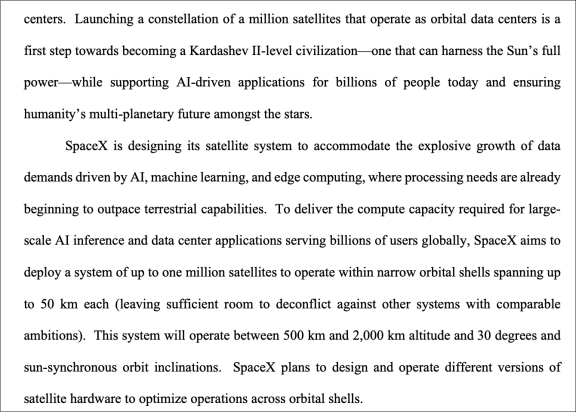
The most striking element of SpaceX’s filing is the number: one million satellites.
To put this in perspective:
- As of 2026, there are fewer than 15,000 active satellites in orbit.
- Starlink alone accounts for over half of them.
- A million satellites would increase the satellite population by nearly two orders of magnitude.
SpaceX proposes operating these satellites in “narrow orbital shells spanning up to 50 kilometers each,” carefully separated to reduce collision risk and allow coexistence with other systems. The filing suggests inclinations ranging from 30 degrees to sun-synchronous orbits, optimizing solar exposure and coverage.
This density raises serious questions about orbital safety, traffic management, and long-term sustainability—issues that regulators and astronomers have already raised in response to much smaller constellations.
Technology Behind the Orbital Data Center
Satellite Design and Computing Hardware
SpaceX has not disclosed detailed specifications for the satellites themselves. The FCC filing notes that the company plans to deploy “different versions of satellite hardware to optimize operations across orbital shells.”
Industry analysts speculate that these satellites would likely include:
- Specialized AI accelerators (GPUs, TPUs, or custom ASICs)
- High-bandwidth optical interconnects
- Radiation-hardened components
- Advanced thermal management systems
Interestingly, recent experiments by companies like Nvidia—sending GPUs into orbit for testing—suggest that the industry is already exploring how conventional data center hardware can be adapted for space.
Optical Links and Networking
Laser-based optical links are essential to the concept. These links allow satellites to communicate at extremely high data rates with minimal latency. In an orbital data center, computation might be distributed across hundreds or thousands of satellites, requiring fast and reliable interconnects similar to those inside terrestrial supercomputers.
Starlink’s existing optical network provides a foundation, but scaling it to support intensive AI workloads will require major advances in routing, synchronization, and fault tolerance.
Launch and Deployment: The Role of Starship
Deploying one million satellites would be impossible with traditional launch systems. SpaceX’s Starship—a fully reusable heavy-lift rocket—is central to the plan. Designed to carry massive payloads at dramatically lower cost per kilogram, Starship could enable bulk deployment of satellites at an unprecedented rate.
Without Starship, the orbital data center concept would remain economically unviable.
Regulation and the FCC Challenge
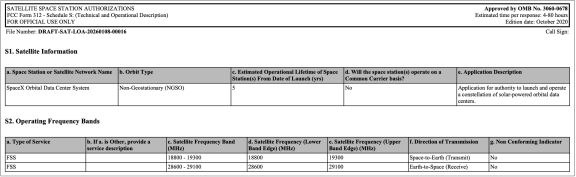
SpaceX’s proposal will face intense scrutiny from regulators, starting with the FCC. While the commission has approved thousands of Starlink satellites, it has also demonstrated caution, recently declining to authorize the full scope of SpaceX’s second-generation constellation.
Key regulatory concerns include:
- Orbital congestion and collision risk
- Radio frequency interference
- Impact on astronomical observations
- Space debris and end-of-life disposal
Approving a million satellites would require not only technical assurances but potentially new regulatory frameworks for managing near-Earth orbit.
Space Debris and Orbital Sustainability
Critics argue that deploying such a vast number of satellites could dramatically increase the risk of cascading collisions, known as the Kessler Syndrome, in which debris impacts generate more debris, eventually making certain orbits unusable.
SpaceX has emphasized autonomous collision avoidance, rapid deorbiting of failed satellites, and narrow orbital shells as mitigation strategies. However, many experts remain skeptical that current technologies are sufficient at this scale.
The orbital data center proposal thus forces a broader conversation: how much commercial activity can near-Earth orbit sustain before it becomes dangerously crowded?
Astronomy and Scientific Concerns
Astronomers have already raised alarms about satellite constellations interfering with ground-based observations. Reflections from satellites can streak across telescope images, complicating research into everything from near-Earth asteroids to distant galaxies.
A million satellites could significantly worsen these effects unless new mitigation techniques—such as darker coatings, orientation control, or orbital coordination—are widely adopted.
The AI Angle: xAI, OpenAI, and Competition
The orbital data center filing has fueled speculation about SpaceX’s relationship with xAI, Elon Musk’s AI company. Analysts suggest that space-based compute could give xAI a strategic advantage, particularly as competition with firms like OpenAI, Google, and Meta intensifies.
AI is increasingly constrained not by algorithms, but by access to compute and energy. If SpaceX can provide effectively unlimited solar-powered computation in orbit, it could reshape the competitive landscape.
At the same time, critics question whether the latency and complexity of space-based compute can truly rival Earth-based hyperscale data centers for most workloads.
Economics and the SpaceX IPO
Reports suggest that SpaceX is preparing for an initial public offering (IPO), potentially raising tens of billions of dollars. The orbital data center project may serve both as a long-term growth vision and a narrative to attract investors.
Satellite industry analyst Tim Farrar has noted that while SpaceX may not need massive new funding for Starlink and Starship alone, xAI’s appetite for capital is enormous. The orbital data center concept could provide a rationale for closer integration between SpaceX and xAI.
Still, the economics remain uncertain. Building, launching, and operating a million satellites—even at reduced costs—would require extraordinary capital investment and long-term confidence in demand.
Global Implications and Geopolitics
A space-based AI infrastructure controlled by a single private company raises geopolitical questions. Governments may worry about:
- Dependence on foreign-owned orbital infrastructure
- Data sovereignty and security
- Military and dual-use applications
Other nations and companies may respond by accelerating their own space-based computing or by pushing for international regulations governing orbital infrastructure.
Is the Vision Realistic?
Supporters argue that many transformative technologies—from reusable rockets to global satellite internet—once seemed unrealistic until SpaceX made them routine.
Skeptics counter that a million-satellite orbital data center represents not just an engineering challenge, but a regulatory, environmental, and social one of unprecedented scale.
The truth likely lies somewhere in between. The FCC filing may represent an early-stage vision rather than a finalized plan, designed to stake a claim and open a dialogue with regulators.
The Future of Computing Beyond Earth
Whether or not SpaceX ultimately deploys a million satellites, the concept of orbital data centers is unlikely to disappear. As AI demand continues to grow and Earth-based resources face limits, space will increasingly be seen as a potential extension of digital infrastructure.
In that sense, SpaceX’s proposal may be less about immediate execution and more about redefining what is possible. Just as Starlink reframed access to the internet, orbital data centers challenge the assumption that the cloud must remain grounded.
SpaceX’s proposal to deploy up to one million satellites as orbital data centers is one of the boldest ideas ever put forward in the history of both spaceflight and computing. It sits at the intersection of AI, energy, infrastructure, and orbital sustainability, raising as many questions as it answers.
If successful, it could usher in a new era in which computation is no longer constrained by terrestrial limits, powered instead by the Sun and distributed across the sky. If it fails—or is curtailed by regulation—it will still have pushed the conversation forward, forcing governments, scientists, and technologists to grapple with the future of space as a shared resource.
Either way, the filing marks a pivotal moment: a signal that the next frontier of AI may not be on Earth at all, but in orbit above it.
Frequently Asked Questions (FAQ)
1. What is SpaceX’s Orbital Data Center?
SpaceX’s Orbital Data Center is a proposed network of satellites designed to function as space-based data centers. These satellites would provide large-scale computing power for artificial intelligence (AI), cloud services, and data-intensive applications using solar energy in orbit.
2. Why does SpaceX want to deploy up to one million satellites?
SpaceX argues that future AI systems serving billions of users will require unprecedented computing capacity and energy. Deploying up to one million satellites would allow computation to be distributed globally and powered by abundant solar energy, reducing reliance on Earth-based data centers.
3. How is this different from Starlink?
Starlink is primarily a satellite internet service that provides broadband connectivity. The Orbital Data Center concept goes beyond connectivity by embedding powerful computing hardware into satellites, effectively turning the constellation into a distributed AI and cloud computing platform.
4. How would the satellites be powered?
The satellites would be powered mainly by solar energy. By operating in carefully selected orbits, including sun-synchronous orbits, they can receive near-continuous sunlight to support energy-hungry computing workloads.
5. How would data be transmitted between satellites and Earth?
Data would move through high-speed optical (laser) links between satellites and then down to Earth via Starlink ground stations, allowing efficient global data routing.
6. Would space-based data centers be faster than Earth-based ones?
For some applications—such as global AI inference and long-distance data routing—space-based systems could offer latency advantages. However, terrestrial data centers will likely remain more efficient for many local or compute-heavy workloads.
7. What role does Starship play in this plan?
Starship is essential. Its high payload capacity and full reusability are designed to drastically lower launch costs, making it economically feasible to deploy satellites at the scale SpaceX is proposing.
8. What are the main regulatory challenges?
The project must receive approval from the U.S. Federal Communications Commission (FCC). Major concerns include orbital congestion, collision risks, radio interference, space debris mitigation, and long-term orbital sustainability.
9. Does deploying one million satellites increase space debris risks?
Yes. Many experts warn that such a large constellation could increase collision risks and debris generation. SpaceX proposes mitigation measures like autonomous collision avoidance and controlled deorbiting, but their effectiveness at this scale remains uncertain.
10. How could this affect astronomy?
Large satellite constellations can interfere with astronomical observations by reflecting sunlight and creating streaks in telescope images. A constellation of this size could significantly worsen these effects without strong mitigation strategies.
11. Is this project connected to Elon Musk’s AI company, xAI?
There is no official confirmation, but analysts believe orbital data centers could provide massive computing resources that would benefit xAI, fueling speculation about closer integration between the companies.
12. How much would the orbital data center project cost?
SpaceX has not released cost estimates. Even with reusable rockets and mass-produced satellites, the total cost would likely reach tens or hundreds of billions of dollars over many years.
13. Is this a realistic plan or just a concept?
At present, the proposal appears to be early-stage and conceptual. While SpaceX has a history of executing ambitious projects, the scale presents unprecedented technical, regulatory, and environmental challenges.
14. When could orbital data centers become operational?
No official timeline has been announced. If approved, early deployments could begin in the late 2020s or early 2030s, with gradual expansion over many years.
15. What does this mean for the future of computing?
Orbital data centers could redefine where computing infrastructure is located, extending the cloud into space. Even if the full vision is never realized, the concept is likely to influence future approaches to AI, energy use, and global computing infrastructure.
Leave a Reply