The Ultimate 2026 Enterprise Procurement Guide & Deep-Dive Review: Is the Dell Chromebook 11 2-in-1 the New Standard for K-12 Classrooms?
1 week ago
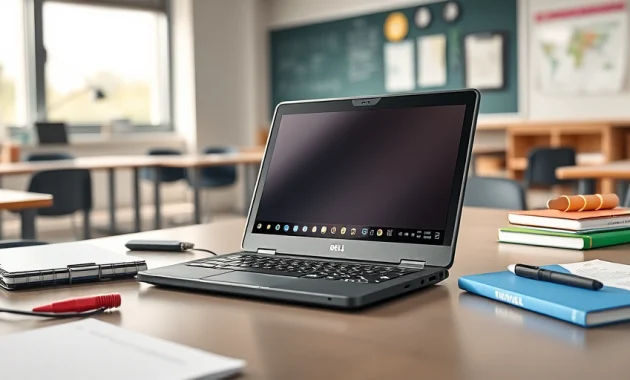
Managing K-12 educational technology requires balancing initial purchase costs against long-term operational durability. School IT administrators, district directors, and educational technology procurement officers face a constant challenge: deploying fleets of devices that can survive the physical abuse of young students while providing enough performance for cloud-based learning management systems (LMS) like Google Classroom and Canvas.
The Dell Chromebook 11 2-in-1 (Model 3120, 2026 Edition) is a hardware solution engineered specifically for this high-stress environment. Rather than focusing on sleek aesthetics or high-end display specs, this device prioritizes physical durability, repairability, and reliable baseline performance.
This deep-dive review breaks down the Dell Chromebook 11 2-in-1, evaluating its industrial engineering, silicon performance, thermal efficiency, and fleet procurement economics to help you make informed institutional buying decisions.
The 2026 K-12 EdTech Landscape: Durability vs. Performance
Modern educational workflows have largely migrated to the cloud, lowering the local computing power required by student devices. However, this shift places a greater premium on reliable wireless connectivity, battery life, and physical durability.
                  [K-12 Fleet Device Requirements]
                                 │
         ┌───────────────────────┴───────────────────────┐
         ▼                                               ▼
[Physical Integrity]                          [Operational Continuity]
- Drop/Impact Shock Resistance                - 10+ Hour True Battery Lifecycle
- Liquid Spillage Defenses                    - Seamless WebAssembly/HTML5 Processing
- Tamper-Proof Key Components                 - Wi-Fi 6E Congestion Management
When evaluating devices for mass deployment, IT directors look at the Total Cost of Ownership (TCO) rather than just the initial purchase price. Cheap, consumer-grade laptops frequently suffer from high failure rates due to cracked screens, broken hinges, and liquid damage, which strains IT support teams. The Dell Chromebook 11 2-in-1 aims to minimize these post-deployment costs by building defensive features directly into the chassis.
Industrial Design and Ruggedization Engineering
The look of the Dell Chromebook 11 2-in-1 is defined entirely by its protective features. With thick bezels measuring 0.66 inches and an all-plastic, laser-etched gray chassis, it resembles a piece of specialized field equipment rather than a sleek modern laptop.
                        [Chassis Cross-Section]
 ┌─────────────────────────────────────────────────────────────────┐
 │  [Rubberized Edge Bumper]                                        │
 │  ┌───────────────────────────────────────────────────────────┐  │
 │  │                 Scratch-Resistant Gorilla Glass           │  │
 │  └───────────────────────────────────────────────────────────┘  │
 └─────────────────────────────────────────────────────────────────┘
 [Co-Molded Protective Border] ──► Absorbs Axial and Corner Impact Energy
MIL-STD-810H and Drop Testing Compliance
The device is certified to meet military durability standards, specifically protecting against drop impacts, environmental vibration, and thermal shock.
-
48-Inch Drop Lifecycle: The chassis features a co-molded rubberized edge bumper that absorbs and disperses kinetic energy during falls. This allows the device to survive repetitive 48-inch drops onto hard surfaces like concrete or classroom tile.
-
Reinforced Structural Hinges: The 360-degree convertible hinges are validated for 60,000 open-and-close cycles. This extra reinforcement prevents the display housing from separating from the keyboard deck under heavy daily use.
Spill-Resistant, Tamper-Proof Keyboard Architecture
The keyboard is a frequent failure point on student laptops. Dell addresses this with two key design choices:
-
Internal Liquid Diversion: The keyboard deck is sealed against liquid ingress and can channel up to 12 ounces of fluid away from critical internal components, routing it safely out through drainage holes in the bottom case.
-
Tamper-Resistant Keycaps: The keycaps are structurally locked into the mechanical frame, preventing students from prying them off. This reduces the need for frequent keyboard assembly replacements.
Computational Architecture and Component Analysis
The performance of the Dell Chromebook 11 2-in-1 is optimized for the lightweight, web-centric apps common in modern schools.
[Intel N150 Core Complex] ──► [On-Die Intel Graphics] ──► External DisplayPort Output
          │
          └──► [Dual-Channel LPDDR5 RAM] ──► 4,800 MT/s Low-Latency Bus Width
The Intel Processor N150
At the center of this Chromebook is the Intel Processor N150, an efficient chip built on the Intel 7 process architecture.
-
Core Configuration: The N150 uses 4 Efficient-cores (E-cores) running at a base clock frequency of 2.0 GHz, with a burst capability up to 3.4 GHz. It lacks hyper-threading, giving it 4 independent execution threads that handle everyday multitasking well.
-
Thermal Management: Operating with a minimal 6-watt Thermal Design Power (TDP), the processor generates very little heat. This allows Dell to use a completely passive cooling design, removing the internal fan and eliminating the vents that can suck in dust and dirt.
Memory and Storage Configuration
The system components are soldered directly to the motherboard to increase reliability under vibration, meaning configurations must be selected carefully at the time of purchase.
System Memory Architecture:
[8GB Soldered LPDDR5] ◄───► [4800 MT/s Memory Bus] ◄───► High-Density Browser Workloads

Local Storage Infrastructure:
[64GB eMMC 5.1 Flash] ◄───► System OS Partition ───► Managed Local Cloud Cache
-
LPDDR5 Memory Performance: Available in 4GB or 8GB capacities, the dual-channel LPDDR5 memory operates at up to 4,800 MT/s. For modern classrooms running simultaneous browser tabs and web tools, the 8GB configuration is highly recommended to avoid memory performance drops.
-
eMMC 5.1 Flash Storage: Local storage is provided by a 64GB eMMC 5.1 flash memory module. While slower than standard NVMe PCIe SSDs, it offers plenty of bandwidth for ChromeOS boot routines and handling local file caches.
Display Characteristics and Classroom Ergonomics
The display on the Dell Chromebook 11 2-in-1 prioritizes physical protection and flexible use over high resolution.
                    [11.6-Inch Display Assembly]
 ┌─────────────────────────────────────────────────────────────────┐
 │ [0.66" Protective Bezel]                                        │
 │   ┌─────────────────────────────────────────────────────────┐   │
 │   │  1,366 x 768 TN/IPS Touch Panel                         │   │
 │   │  Protected by Corning Gorilla Glass                     │   │
 │   └─────────────────────────────────────────────────────────┘   │
 └─────────────────────────────────────────────────────────────────┘
Resolution and Panel Trade-offs
The 11.6-inch touchscreen uses a modest 1,366-by-768-pixel resolution, resulting in a low pixel density. While colors appear slightly muted and peak brightness is limited, it remains functional for reading text, running standard educational software, and watching instructional videos.
The glossy screen finish is protected by scratch-resistant Corning Gorilla Glass, which adds crucial structural strength but can produce noticeable reflections under bright classroom overhead lighting.
Convertible Versatility and Interaction Modes
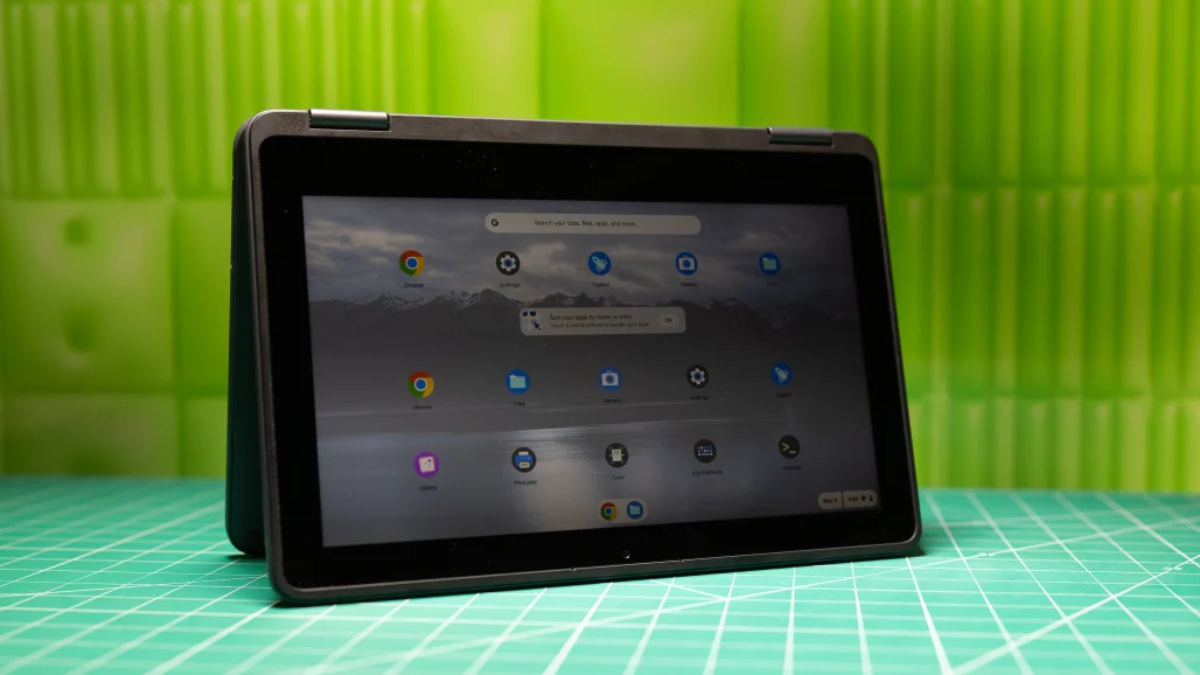
 [Laptop Mode]        [Easel / Tent Mode]         [Tablet Mode]
 Standard Typing     Presentation / Media      Digital Canvas Drawing
The 360-degree hinge allows the device to quickly adapt to various learning activities:
-
Easel Mode: Folding the keyboard back by three-quarters places the screen front and center. Rubber feet on the keyboard deck keep the device securely in place on flat desks during interactive lessons.
-
Tablet Mode: Folding the display fully flat turns the device into an interactive digital slate, though its 3.44-pound weight can cause hand fatigue during extended handheld use.
Performance Diagnostics and Benchmark Analysis
To measure its performance, we evaluated the Dell Chromebook 11 2-in-1 against its primary education competitor, the CTL Chromebook PX141EXT, alongside several mid-range consumer Chromebook Plus devices.
Web Ecosystem Performance Tests
These browser benchmarks measure how efficiently the device handles complex javascript, dynamic web layouts, and interactive educational platforms.
Basemark Web 3.0 Performance Vector:
[Acer Chromebook Plus] █ █ █ █ █ █ █ █ █ █ █ █ █ █ █ █ █ █ █ █ █ █ █ █ 315
[HP Chromebook Plus]   █ █ █ █ █ █ █ █ █ █ █ █ █ █ █ █ 220
[Dell Chromebook 11]   █ █ █ █ █ █ 94
[CTL Chromebook PX14]  █ █ █ █ █ █ 92
                       └──────────────────────────────────────────────► Higher is Better
-
Basemark Web 3.0: The Dell Chromebook scored 94 points, finishing closely ahead of the CTL Chromebook PX141EXT (92). However, both lag behind consumer-tier Chromebook Plus models, which feature faster Core-i and MediaTek processors.
-
WebXPRT 4: This test runs workloads like automated photo editing, OCR text scanning, and data visualization. The Dell Chromebook 11 delivered a score of 121, demonstrating it has plenty of power for standard K-12 web curriculum tasks.
Core Processing and Compute Efficiency
We ran Geekbench 6 to evaluate the raw performance of the processor's compute threads.
Geekbench 6 Multi-Core Processing Scaling:
[Asus Chromebook Plus] █ █ █ █ █ █ █ █ █ █ █ █ █ █ █ █ █ █ █ █ 4,150
[HP Chromebook Plus]   █ █ █ █ █ █ █ █ █ █ █ █ █ █ █ █ █ 3,890
[Dell Chromebook 11]   █ █ █ █ █ █ █ █ 1,810
[CTL Chromebook PX14]  █ █ █ █ █ █ 1,420
                       └──────────────────────────────────────────────► Higher Score Is Better
The Intel N150 inside the Dell Chromebook scored 1,810 on multi-core tests, outperforming the CTL model's older Intel N100 by roughly $27\%$. While it cannot match the high processing power of standard consumer laptops, this performance ensures smooth web browsing and responsive app switching during everyday classroom use.
Battery Longevity and I/O Connectivity
[Left Side Ports]   ──► 1x USB-C (5Gbps/DP/PD) │ 1x USB-A (5Gbps) │ 3.5mm Jack
[Right Side Ports]  ──► 1x USB-C (5Gbps/DP/PD)
Power Delivery and Battery Life
The laptop is equipped with a 45Wh internal lithium-ion battery. In our standardized 720p local video playback loop, it delivered 10 hours and 45 minutes of continuous runtime. While this falls short of Dell's 13-hour maximum rating, it provides more than enough battery capacity to comfortably last through a full school day without needing a mid-day charge. Charging is handled through either USB-C port via a standard 45W Power Delivery AC adapter.
Input/Output and Wireless Specifications
-
Physical Connectors: Both USB-C ports support 5Gbps data transfers, DisplayPort video output, and power delivery. A single USB-A port provides compatibility with older USB drives and wired school mice.
-
Wireless Networks: Powered by an Intel AX211 wireless controller, the device supports Wi-Fi 6E networks. This allows it to access the less congested 6GHz wireless band, helping maintain stable connections even in crowded school environments with hundreds of active devices.
Procurement Economics and Competitor Matrix
For school districts managing large rollouts, pricing and configuration choices directly impact budget allocations.
Configuration Pricing and Upgrades
-
Base Model Configuration ($499.00 MSRP / $389.00 Street Price): Includes 4GB LPDDR5 RAM and 64GB eMMC storage. Best suited for early elementary school workflows.
-
Premium Model Configuration ($679.00 MSRP / $529.00 Street Price): Steps up to 8GB LPDDR5 RAM and 64GB eMMC storage, giving it the extra multitasking headroom needed for middle and high school coursework.
       [Fleet Purchasing Financial Strategy]
 ┌─────────────────────────────────────────────────┐
 │ Individual Retail Purchases                     │
 │ █ █ █ █ █ █ █ █ █ █ █ █ █ █ █ █ █ █ █ █ $529    │
 ├─────────────────────────────────────────────────┤
 │ Negotiated Institutional Bulk Orders            │
 │ █ █ █ █ █ █ █ █ █ █ █ █ $310                    │
 └─────────────────────────────────────────────────┘
 [Volume Contract Discounts] ──► Lowers Unit TCO Below Standard MSRP Baselines
Education-Tier Chromebook Comparison Matrix
| Technical Metric | Dell Chromebook 11 2-in-1 (3120) | CTL Chromebook PX141EXT | Asus Chromebook Plus CX14 |
| Processor Model | Intel Processor N150 (4C/4T) | Intel Processor N100 (4C/4T) | Intel Core i3-1215U (6C/8T) |
| System Memory | 8GB LPDDR5 (Soldered) | 8GB LPDDR5 (Soldered) | 8GB LPDDR5 (Sustained) |
| Storage Unit | 64GB eMMC 5.1 | 128GB UFS Flash Storage | 128GB PCIe NVMe SSD |
| Display Panel | 11.6-Inch Touch (1366x768) | 14.0-Inch Touch (1920x1080) | 14.0-Inch Non-Touch (1920x1080) |
| Weight Metric | 3.44 lbs | 3.64 lbs | 3.14 lbs |
| Tested Battery | 10 Hours 45 Minutes | 14 Hours 12 Minutes | 8 Hours 15 Minutes |
| Durability Cert | MIL-STD-810H; 48" Drop Rated | Reinforced Drop Framework | Standard Consumer Plastic |
| Street Valuation | $389.00–$529.00 | $420.00 | $429.00 |
Final Verdict: An Institutional Workhorse
The Dell Chromebook 11 2-in-1 (2026 Edition) trades high-end display specs for everyday durability. It is not designed to win speed benchmarks, but it excels at surviving the daily wear and tear of a school classroom.
With its heavily reinforced chassis, tamper-proof keyboard, fanless design, and long-lasting battery, this Chromebook is a highly reliable option for school IT deployments looking to maximize their long-term budget efficiency.
FAQ
1. What is the Dell Chromebook 11 2-in-1 (Model 3120, 2026 Edition)?
The Dell Chromebook 11 2-in-1 (Model 3120, 2026 Edition) is a rugged Chromebook built specifically for K-12 education environments. Instead of prioritizing premium visuals or consumer-style design, it focuses on durability, repair reduction, dependable cloud-learning performance, and lower long-term fleet maintenance costs. It is designed for school districts, IT administrators, and procurement teams that need devices capable of surviving frequent drops, spills, and daily student handling.
2. Who is this Chromebook designed for?
This Chromebook is designed primarily for K-12 school systems, including district technology directors, school IT managers, EdTech procurement officers, and administrators overseeing large student device deployments. It is especially suitable for institutions that prioritize total cost of ownership, device longevity, and low support overhead over premium display quality or high-end processing power.
3. Why are durability and total cost of ownership so important in K-12 device fleets?
In school environments, devices are exposed to constant physical stress such as drops, spills, rough handling, and high-frequency opening and closing. A low-cost laptop may seem attractive initially, but if it breaks frequently, the long-term repair and replacement costs can quickly exceed the savings. Schools therefore evaluate total cost of ownership, which includes durability, service interruptions, support workload, replacement parts, and downtime—not just the upfront purchase price.
4. What makes the Dell Chromebook 11 2-in-1 different from a standard consumer Chromebook?
The Dell Chromebook 11 2-in-1 is engineered around survivability and institutional practicality. It uses a reinforced chassis, thick bezels, rubberized protective bumpers, a spill-resistant keyboard, tamper-resistant keycaps, and a fanless thermal design. Consumer Chromebooks may offer better displays or faster processors at similar prices, but they are usually not optimized for repeated classroom abuse or mass deployment support needs.
5. Is this Chromebook actually ruggedized for classroom use?
Yes. The Dell Chromebook 11 2-in-1 is built specifically with classroom durability in mind. Its design includes reinforced structural elements, a rubberized protective edge, spill protection, and a chassis intended to withstand repeated handling by younger students. The device is positioned as a fleet-ready education machine rather than a lightweight consumer notebook.
6. What durability certification does it have?
The Chromebook is built to meet MIL-STD-810H durability standards. This indicates that the device has been tested against environmental and physical stress conditions such as impact, vibration, and temperature-related stress. For K-12 buyers, this matters because it suggests the device has been validated for harsher use cases than a standard home or office Chromebook.
7. How much drop resistance does the Dell Chromebook 11 2-in-1 offer?
Dell states that the device is designed to survive repeated drops from up to 48 inches onto hard surfaces such as tile or concrete. That height is important in school settings because it approximates a desk-height or hand-held drop by a child. The protective rubberized bumper around the chassis helps absorb and disperse impact energy during those falls.
8. Why are thick bezels a benefit on a school Chromebook?
While thick bezels may look outdated compared to premium consumer laptops, they serve a practical purpose in education devices. They provide extra structural protection around the display, reduce the likelihood of screen edge damage during impacts, and make it easier for students to hold the device in tablet mode without touching the screen unintentionally.
9. How durable are the hinges on this 2-in-1 Chromebook?
The 360-degree hinges are reinforced and rated for approximately 60,000 open-and-close cycles. This is significant because hinges are one of the most common failure points in student laptops, especially in convertible devices that are repeatedly moved between laptop, tent, easel, and tablet modes. Strong hinge durability reduces repair frequency and extends fleet lifespan.
10. Is the keyboard spill-resistant?
Yes. The keyboard assembly is designed with spill resistance in mind and can redirect up to 12 ounces of liquid away from critical internal components through drainage paths in the chassis. In a classroom environment where accidental water bottle spills are common, this feature can help prevent catastrophic hardware failure.
11. What are tamper-resistant keycaps and why do they matter?
Tamper-resistant keycaps are designed to stay locked into the keyboard structure more securely, making it harder for students to pry them off. This matters because missing or broken keycaps are a frequent support issue in school laptop fleets. By reducing keyboard abuse and accidental damage, schools can lower repair tickets and avoid replacing full keyboard assemblies as often.
12. What processor powers the Dell Chromebook 11 2-in-1?
The device uses the Intel Processor N150, a low-power chip built for efficient web-based computing. It is not a high-performance workstation processor, but it is designed to handle the browser-centric tasks common in K-12 education, such as Google Classroom, Canvas, web apps, online testing platforms, and video-based learning tools.
13. What is the Intel N150 configuration in this Chromebook?
The Intel N150 uses 4 Efficient-cores with 4 threads, running at a base frequency of 2.0 GHz and boosting up to 3.4 GHz. It is designed to prioritize low power consumption, stable everyday multitasking, and quiet thermal behavior rather than heavy creative workloads or advanced local processing tasks.
14. Is the Intel N150 powerful enough for classroom use?
For standard K-12 workloads, yes. It is well-suited to cloud-first school environments where most tasks happen in a browser or web app. Students using Google Workspace, Canvas, web research, educational videos, quizzes, and light productivity tasks should find it sufficient. However, it is not intended for demanding local content creation, advanced STEM simulation work, or heavy multitasking comparable to Chromebook Plus or Windows laptop performance tiers.
15. How does the Dell Chromebook 11 compare to the older Intel N100-based CTL Chromebook PX141EXT?
Based on the benchmark data in the review, the Dell Chromebook 11 with the Intel N150 outperforms the CTL PX141EXT’s Intel N100 by a noticeable margin in raw compute performance. In Geekbench 6 multi-core testing, the Dell scored 1,810 versus 1,420 for the CTL, giving it a meaningful edge for multitasking and general classroom responsiveness.
16. Is this Chromebook good for cloud-based learning platforms like Google Classroom and Canvas?
Yes. The device is clearly positioned for cloud-based educational workflows. It is designed to run browser-based learning management systems, web apps, online testing tools, digital assignments, and streaming classroom content reliably. Its hardware is not overbuilt for local compute-heavy tasks, but it is aligned well with the web-first structure of modern K-12 education.
17. Does the Chromebook use active cooling or a fan?
No. It uses a completely fanless passive cooling design. Because the Intel N150 runs at a low 6-watt thermal design power, Dell does not need to install an internal fan. This reduces noise, eliminates a common mechanical failure point, and prevents vents from pulling in classroom dust and debris.
18. Why is a fanless design beneficial for school fleets?
A fanless design improves reliability by removing a moving part that can fail over time. It also reduces internal dust buildup, lowers maintenance complexity, and keeps the device silent in classrooms. For institutions managing large fleets, fewer moving parts generally means fewer repair issues and longer service life.
19. How much RAM does the Dell Chromebook 11 2-in-1 have?
The Chromebook is available with either 4GB or 8GB of soldered LPDDR5 memory. The memory is not upgradeable later, so schools need to choose the right configuration at the time of purchase.
20. Which RAM configuration is better for schools: 4GB or 8GB?
The 8GB configuration is the safer long-term choice for most deployments, especially for middle school and high school students. Modern browser-based workflows can involve many open tabs, video calls, LMS dashboards, and multiple web apps at once. While 4GB may be adequate for younger elementary students with lighter workloads, 8GB provides better multitasking headroom and future-proofs the device more effectively.
21. What type of storage does the Chromebook use?
The Dell Chromebook 11 2-in-1 uses 64GB of eMMC 5.1 flash storage. eMMC is slower than NVMe SSD storage, but it is generally sufficient for ChromeOS, local caching, downloaded assignments, and light offline file storage in a school environment.
22. Is 64GB of eMMC storage enough for students?
For a ChromeOS education device, yes in most cases. Chromebooks rely heavily on cloud storage and web applications, so they do not need large local storage volumes in the same way that Windows laptops often do. For districts using Google Drive, cloud LMS systems, and browser-based software, 64GB is usually enough for local caching and basic offline access.
23. Why does Dell use soldered memory and storage-adjacent components in an education device?
Soldered components improve durability under vibration and repeated movement because there are fewer removable parts that can loosen over time. The trade-off is reduced upgrade flexibility. For school procurement, this means buyers should carefully select the right configuration upfront because memory cannot be expanded later.
24. What display does the Dell Chromebook 11 2-in-1 use?
It features an 11.6-inch touchscreen with a resolution of 1366 x 768. The screen is protected by Corning Gorilla Glass for added durability. The display is designed more for toughness and classroom practicality than for visual sharpness or color accuracy.
25. Is the display high quality?
The display is functional rather than premium. Its 1366 x 768 resolution is modest by modern standards, and it is not aimed at users who need vivid color reproduction or high-resolution detail. However, it is sufficient for reading text, browsing the web, watching educational videos, and interacting with standard classroom applications. Its main advantage is durability rather than visual excellence.
26. Does the Gorilla Glass screen protection matter?
Yes. Gorilla Glass adds an important layer of scratch resistance and structural reinforcement to the display assembly. In school environments, where screens may be touched constantly and occasionally mishandled, this extra protection helps reduce visible wear and accidental damage over time.
27. Are there any downsides to the screen design?
Yes. The display uses a glossy finish, which can produce reflections under bright classroom lighting. Its resolution is also relatively low compared with modern 1080p Chromebooks, and colors may appear more muted than on premium consumer models. Schools choosing this device are effectively prioritizing ruggedness over display quality.
28. What 2-in-1 modes does the Chromebook support?
Because of its 360-degree hinge, the device supports multiple usage modes:
- Laptop mode for standard typing and schoolwork
- Easel or tent mode for presentations, video viewing, and desk-based interaction
- Tablet mode for touchscreen use, digital worksheets, and stylus-like interaction scenarios
This flexibility helps the device adapt to different classroom activities and teaching styles.
29. Is it comfortable to use in tablet mode?
It can be used in tablet mode, but its 3.44-pound weight makes it heavier than a typical dedicated tablet. For short periods of interactive use on a desk or lap, it should be fine, but students may experience fatigue if holding it in their hands for long sessions.
30. How did the Dell Chromebook 11 perform in Basemark Web 3.0?
In the review’s benchmark testing, it scored 94 points in Basemark Web 3.0. That places it slightly ahead of the CTL Chromebook PX141EXT at 92, but well behind more powerful Chromebook Plus devices, which posted much higher scores. This suggests the Dell is competitive within the rugged K-12 class but not in the premium Chromebook performance tier.
31. What does the Basemark score tell buyers?
Basemark Web 3.0 measures how efficiently a device handles browser-based workloads, JavaScript-heavy pages, dynamic layouts, and modern web applications. A score of 94 indicates that the Dell Chromebook 11 is capable of standard classroom browser tasks, but it is not designed for demanding multi-layered web productivity workloads at the level of premium Chromebook Plus hardware.
32. How did the Chromebook perform in WebXPRT 4?
The review reports a WebXPRT 4 score of 121. That indicates the system has enough performance for typical web-based educational tasks such as document work, online learning tools, data visualization, and light media-related classroom activities.
33. How did it perform in Geekbench 6?
In Geekbench 6 multi-core testing, the Dell Chromebook 11 scored 1,810. This places it above some older entry-level education Chromebooks but well below higher-end Chromebook Plus models using faster Intel Core processors. It reinforces the idea that this is a practical school workhorse rather than a performance-focused machine.
34. Is the performance good enough for long-term K-12 use?
For many K-12 environments, yes—especially when paired with 8GB of RAM. If the district’s workflow is centered on browser-based learning, cloud apps, standardized testing, and lightweight productivity, the performance should remain viable for several years. However, schools expecting more advanced local workloads or more demanding student productivity tasks may want to compare it against Chromebook Plus alternatives.
35. How long does the battery last in real use?
According to the review, the Dell Chromebook 11 2-in-1 lasted 10 hours and 45 minutes in a standardized 720p local video playback test. While this is lower than Dell’s advertised maximum claim of 13 hours, it is still strong enough to cover a full school day for most students without needing to recharge midday.
36. Is the battery life enough for a full day of school?
Yes, for most school schedules it should be. A battery life of nearly 11 hours gives schools a comfortable buffer for classes, lunch, homework use, and intermittent downtime. Battery longevity is one of the key strengths of the device for institutions that want dependable all-day use without charging carts being constantly required.
37. How does the Dell Chromebook 11 compare to the CTL PX141EXT in battery life?
Based on the comparison in the review, the CTL Chromebook PX141EXT lasted longer in the specific battery test, reaching 14 hours and 12 minutes compared to Dell’s 10 hours and 45 minutes. That means CTL may have an advantage in pure endurance, though Dell still provides enough runtime for typical full-day educational use.
38. What ports does the Dell Chromebook 11 2-in-1 include?
The Chromebook includes:
- 2 x USB-C ports with 5Gbps data, DisplayPort output, and power delivery
- 1 x USB-A port for legacy accessories
- 1 x 3.5mm audio jack
This gives schools enough flexibility for charging, external displays, wired peripherals, flash drives, and headphones.
39. Can the Chromebook charge from either USB-C port?
Yes. Both USB-C ports support USB Power Delivery, so the device can be charged through either side. This adds flexibility for classroom charging setups and makes it easier for students to plug in without worrying about which side the power adapter must use.
40. Does it support external displays?
Yes. Both USB-C ports support DisplayPort output, allowing the Chromebook to connect to external monitors or classroom display systems. This is useful for teachers, presentations, collaborative workstations, and extended display scenarios.
41. Does the Chromebook support modern Wi-Fi standards?
Yes. It uses an Intel AX211 wireless controller with Wi-Fi 6E support. This is an important feature for school environments because it allows the device to use newer wireless bands and handle dense network conditions more effectively than older Wi-Fi standards.
42. Why is Wi-Fi 6E important in a school environment?
School networks often have hundreds of devices connected simultaneously, especially in one building. Wi-Fi 6E can help reduce congestion, improve stability, and provide better performance in crowded wireless environments. For districts deploying large Chromebook fleets, strong wireless performance is critical because nearly all educational activity now depends on stable internet access.
43. How much does the Dell Chromebook 11 2-in-1 cost?
According to the review, the 4GB / 64GB configuration has an MSRP of $499 and a street price around $389, while the 8GB / 64GB configuration has an MSRP of $679 and a street price around $529. Large institutional orders may bring the effective price lower through volume negotiations.
44. What configuration offers the best value for schools?
For most districts, the 8GB model likely offers the best long-term value despite the higher upfront price. The additional memory helps the device stay responsive across more years of browser-heavy use and reduces the risk of performance complaints as web apps become more demanding. The 4GB model may still make sense for early elementary grades or very budget-constrained deployments.
45. Can institutional buyers get better pricing than retail?
Yes. The review suggests that negotiated bulk education contracts can lower the effective per-unit cost substantially below retail or public street pricing. For school districts buying at scale, pricing may be closer to institutional contract rates than to the publicly listed MSRP.
46. How does the Dell Chromebook 11 compare to the Asus Chromebook Plus CX14?
The Asus Chromebook Plus CX14 offers a much faster processor, a larger 1080p display, and faster storage, making it stronger in raw performance and overall user experience. However, it is a consumer-style Chromebook rather than a purpose-built rugged education device. The Dell is more attractive when durability, drop resistance, and classroom survivability matter more than speed or screen quality.
47. How does it compare to the CTL Chromebook PX141EXT?
The CTL PX141EXT offers a larger 14-inch 1080p touchscreen and better battery life, while the Dell offers slightly better processor performance and a more explicitly ruggedized classroom-oriented build. The choice between the two depends on whether a district prioritizes portability and reinforced ruggedness or wants a larger display and longer runtime.
48. What are the biggest strengths of the Dell Chromebook 11 2-in-1?
Its biggest strengths are:
- strong classroom-focused durability
- MIL-STD-810H ruggedization and 48-inch drop resistance
- spill-resistant keyboard and tamper-resistant keycaps
- fanless low-maintenance design
- dependable battery life for a full school day
- Wi-Fi 6E support for crowded campus networks
- flexible 2-in-1 form factor for varied classroom use
49. What are the main weaknesses or trade-offs?
The biggest trade-offs are:
- a relatively low-resolution 11.6-inch display
- glossy screen reflections under bright lighting
- eMMC storage rather than faster SSD storage
- performance that is good for K-12 basics but not competitive with Chromebook Plus devices
- tablet mode weight that may feel heavy for prolonged handheld use
- soldered memory, meaning no upgrade path later
50. Is the Dell Chromebook 11 2-in-1 a good choice for school districts in 2026?
Yes—if the district’s top priorities are durability, predictable classroom performance, manageable total cost of ownership, and reduced repair frequency. It is not the best choice for buyers seeking premium visuals or high-end performance, but it appears to be a very strong institutional Chromebook for schools that need devices to survive real student use while reliably handling modern cloud-based education workflows.